
Chicanná
MEXICO / CAMPECHE / MAYA
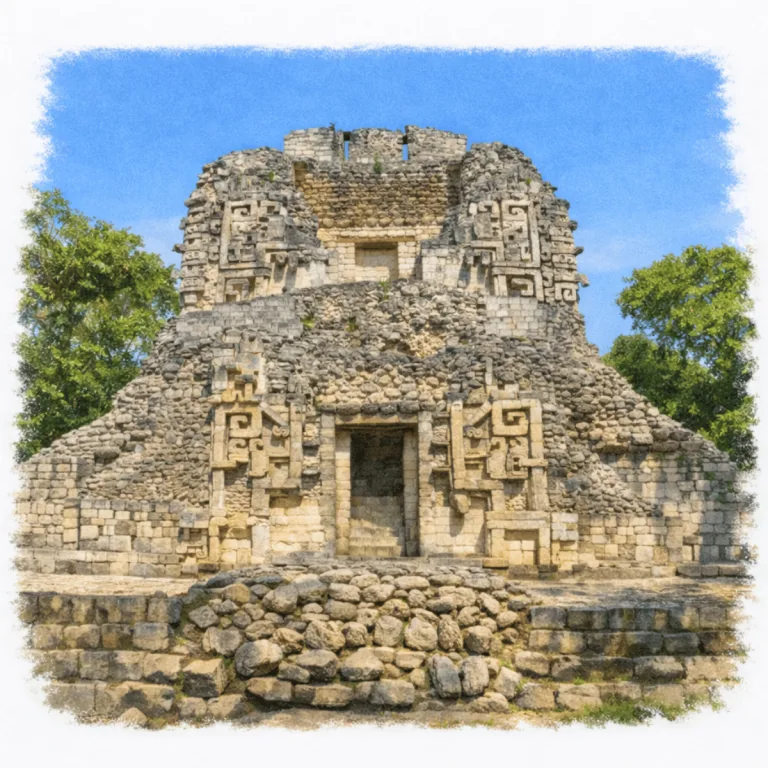
Within the Río Bec region of Campeche, Chicanná presents elaborate façade design, where Structure II’s monster-mouth doorway opens its jaws to the sacred world within.
| Name | Chicanná |
| Civilization | Maya |
| Location | Río Bec Region, Calakmul Municipality, Campeche, Mexico |
| Elevation | 280 m (920 ft) above sea level |
| Years Active | 400 BCE to 1100 CE |
| Primary Resources | Limestone, lime plaster, stored rainwater, agricultural goods |
| Site Type | Elite ceremonial and residential compound |
| Key Highlights | Monster mouth façade, Río Bec architecture, zoomorphic doorway |
| INT Airport | Chetumal International Airport (CTM) |
| Entry Fee | 80 MXN national or resident; 145 MXN foreign visitor |
| Best Time to Visit | Dry season, November to April, early morning |
| Field Visit | Visited and documented by Lost Ruins of the Americas |
Unique Features of the Chicanná
- Monster mouth façade: A sculpted doorway formed from teeth, eyes, and stacked elements that marks the site’s most recognizable structure.
- Río Bec style architecture: Low, symmetrical buildings with refined stonework that show the regional tradition in a compact form.
- Multiroom structures: Several buildings contain linked interior rooms and narrow passages typical of elite residential compounds.
- Carved mask panels: Decorative stone masks and geometric panels that highlight the site’s craftsmanship.
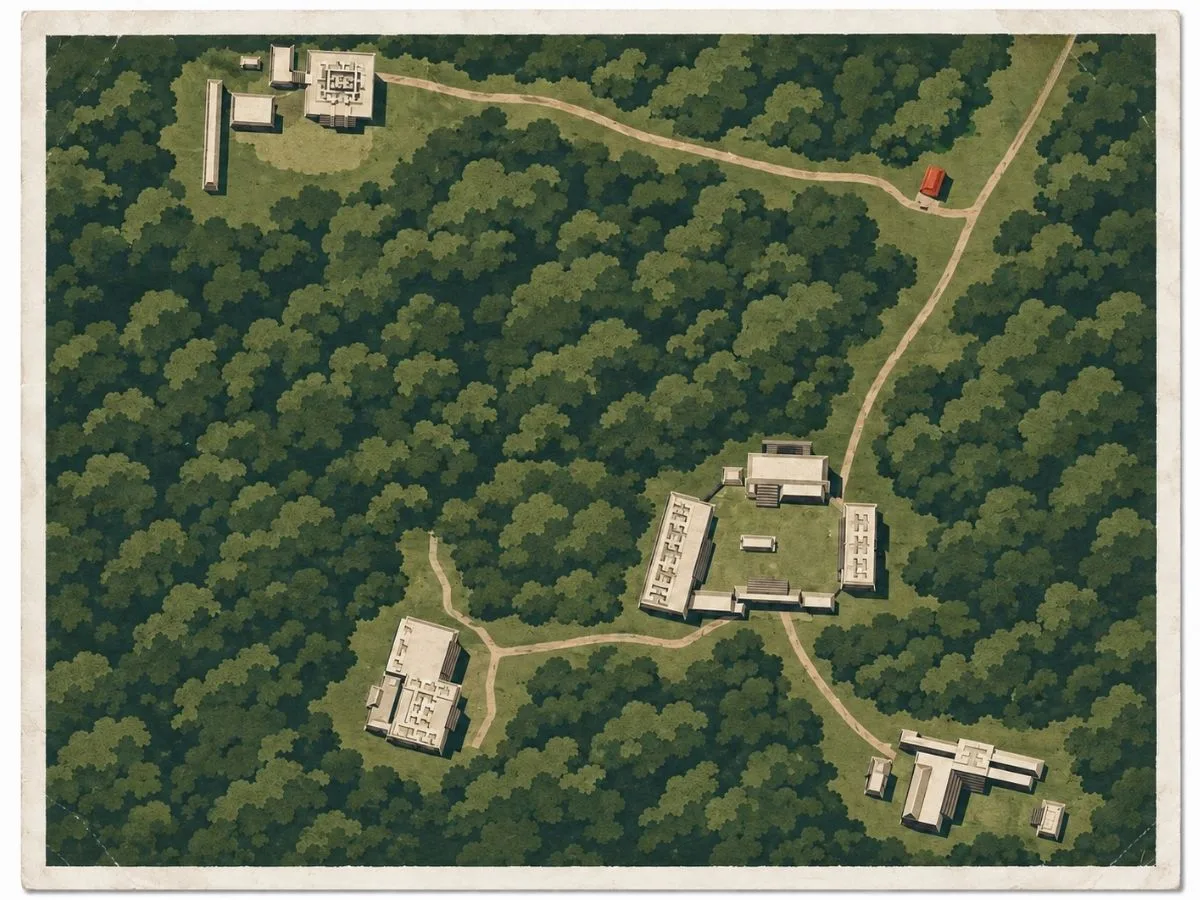
- Compact layout: A small group of structures arranged around tight plaza spaces that make the site easy to navigate.
Location & Access
- Nearest Town: Xpujil, Campeche
- Directions: From Xpujil, take Highway 186 west. Chicanná is signed from the road and sits only a few kilometers from Becán and Xpuhil, making it easy to visit all three sites in one circuit.
- Official Website: INAH Zona Arqueológica Chicanná.
- Opening Hours: 8:00 AM to 5:00 PM, with last access at 4:45 PM.
- Entry Fees: 80 MXN; 145 MXN for foreign visitors.
- Facilities: Basic entrance booth, marked paths, limited shade, no on site vendors.
- Accessibility: Limited. Uneven ground, roots, low platforms, and stone steps restrict access around several structures.
- Pro Tip: Arrange a taxi in Xpujil that waits at Becán, Chicanná, and Xpuhil so you can move through all three without worrying about transport.
Highlights to Help Understand Your Visit
A compact site where meaning is concentrated in façade design and controlled movement.
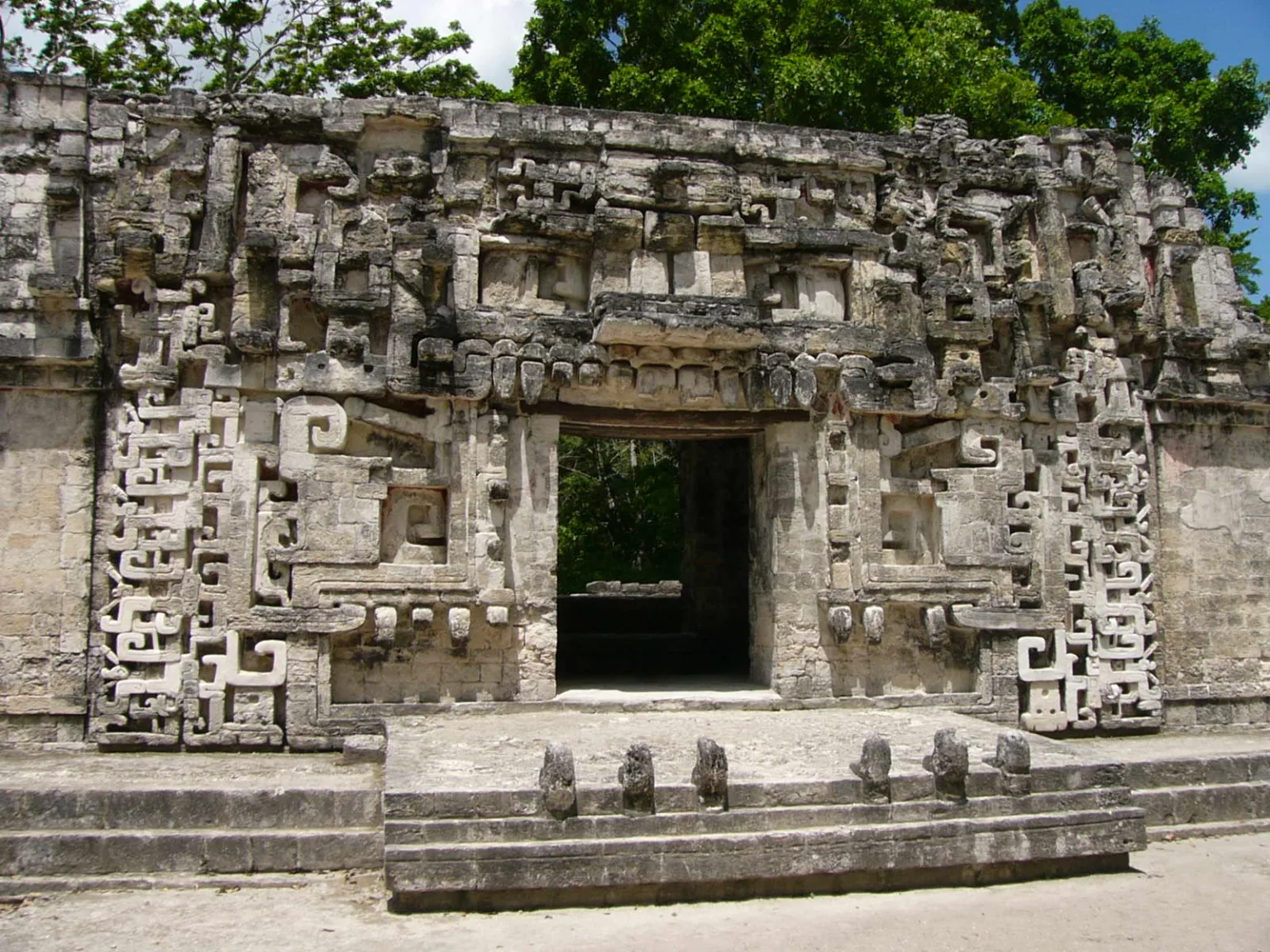
- A doorway that defines the entire visit: The monster mouth entrance at Structure II is not a decoration. It is a symbolic threshold. The carved teeth and eyes set the tone for how the whole compound should be understood.
- Río Bec style in concentrated form: Chicanná shows the same architectural logic found at Xpuhil and Becán, but scaled down. Clean lines, symmetry, and framed rooms guide the visitor through space with quiet precision.
- Movement as message: The path through the plaza pulls the eye toward symbolic features rather than height or mass. The layout teaches visitors to approach each structure as a controlled sequence rather than a broad open space.
- Mythic imagery built into daily life: Masks, fangs, and geometric panels appear across the buildings. These details connect household activity to creator beings and earth monsters that shaped Maya ideas of interior and exterior worlds.
- A residential compound with ceremonial weight: Chicanná blends elite living space with symbolic architecture. The art is part of the place itself, not an isolated shrine or temple.
Key Structures of Chicanná
- Structure I: A Río Bec style building with a long layout, multiple rooms, and decorative panels that show the transition between Río Bec and Chenes influence. Its proportions and symmetry echo nearby sites like Becán and Xpuhil.
- Structure II: The signature monster mouth temple, where the entrance forms the open jaws of a supernatural being. The teeth, eyes, and stacked stone elements create a controlled threshold into an interior space that once held painted plaster and symbolic scenes.
- Structure VI: A temple in the secondary plaza group with traces of façade decoration and a partially preserved roof comb. Later additions along the structure show how ritual rooms and elite residential space blended within the same compound.
- Structure XX: A larger raised platform that once supported carved façades and multiple symbolic entrances. Even in its ruined condition it shows how Chicanná projected ceremonial presence beyond the compact main plaza.
- Residential platforms: Low platforms arranged around the plazas that supported elite dwellings. Their distribution suggests that Chicanná functioned as a high status compound tied closely to the regional centers.
- Decorative mask panels: Stylized masks with eyes, fangs, and geometric forms that link the architecture to mythic beings associated with creation and sacred entry. These panels demonstrate how imagery wrapped the buildings in narrative meaning.
History and Legends
Chicanná developed during the Classic Period, from about 600 to 900 CE, when the Río Bec region supported a network of elite residences and ceremonial compounds. The site was never a large city. Instead, it served as a refined architectural estate linked to nearby Becán, with structures arranged closely around small courtyards. The workmanship suggests skilled builders and a household of status, focused more on symbolism and presentation than scale.
The defining element at Chicanná is Structure II. Its façade is carved as the open jaws of a supernatural creature, complete with teeth, eyes, and layered stone forms that frame the entrance. Passing through such a doorway was understood as a symbolic act. In Maya tradition, portals shaped as creatures or caves marked points where the human world brushed against the sacred. The carved mouth would have guided visitors inward with a sense of transition, echoing long held beliefs about mountains, spirits, and the openings where power was thought to reside.
The surrounding structures follow the Río Bec style, with narrow chambers, decorative masks, and the suggestion of towers that rise from the corners without functioning as real upper levels. These features emphasize appearance and alignment rather than internal volume. At Chicanná the effect is concentrated. The buildings frame pathways, direct movement, and use visual cues to shape how the space is experienced.
Although no written inscriptions survive at the site, the architecture conveys its own message. The imagery reflects stories and symbols common across the region, where carved entrances were linked to creation places and the domains of powerful beings. Local traditions throughout the Maya world describe such openings as points of passage, where one steps briefly into a realm that lies beneath or behind the visible one. The façade at Chicanná preserves that idea. Even today it creates a moment of pause before entering.
Conservation efforts in the twentieth century cleared vegetation and stabilized the façades, revealing the preserved clarity of the carvings. Because the site is small, visitors can appreciate details that might be overlooked at larger ruins. Light shifts across the monster mouth throughout the day, giving shape to the eyes and teeth and highlighting the precision of the stonework. Chicanná remains one of the most accessible sites in the Río Bec region, offering a focused example of how architecture and symbolism were woven together to guide movement and meaning.
How to Get There & Where to Go Next
How to Visit Chicanná
Step-by-step access to the site
- Cancún to Xpujil Station Board the Tren Maya southbound toward Escárcega. Travel time is about 5 to 6 hours.
- Station to Xpujil Town Take a local taxi along Highway 186 for 10 to 15 minutes into town.
- Xpujil to Chicanná Hire a taxi for a short ride to the site. Travel time is about 10 to 12 minutes west along Highway 186.
- Driving from Cancún Take Highway 307 south to Felipe Carrillo Puerto, then merge onto Highway 186 toward Xpujil. Expect 5 to 6 hours depending on stops.
Tips: Hire one taxi in Xpujil to cover Chicanná, Becán, and Xpuhil for a smooth and efficient visit.
Nearby Ruins You Can Visit
These Maya sites share the same forested region and architectural tradition that shaped Chicanná and the wider Río Bec corridor.

Becán – A fortified center with deep moats and monumental structures that anchored power in the region.

Calakmul – A vast Maya Capital with monumental pyramids and royal tombs hidden deep in the Calakmul Biosphere Reserve

Xpuhil – Famous for its three tower temple, a dramatic example of Río Bec design taken to an extreme.
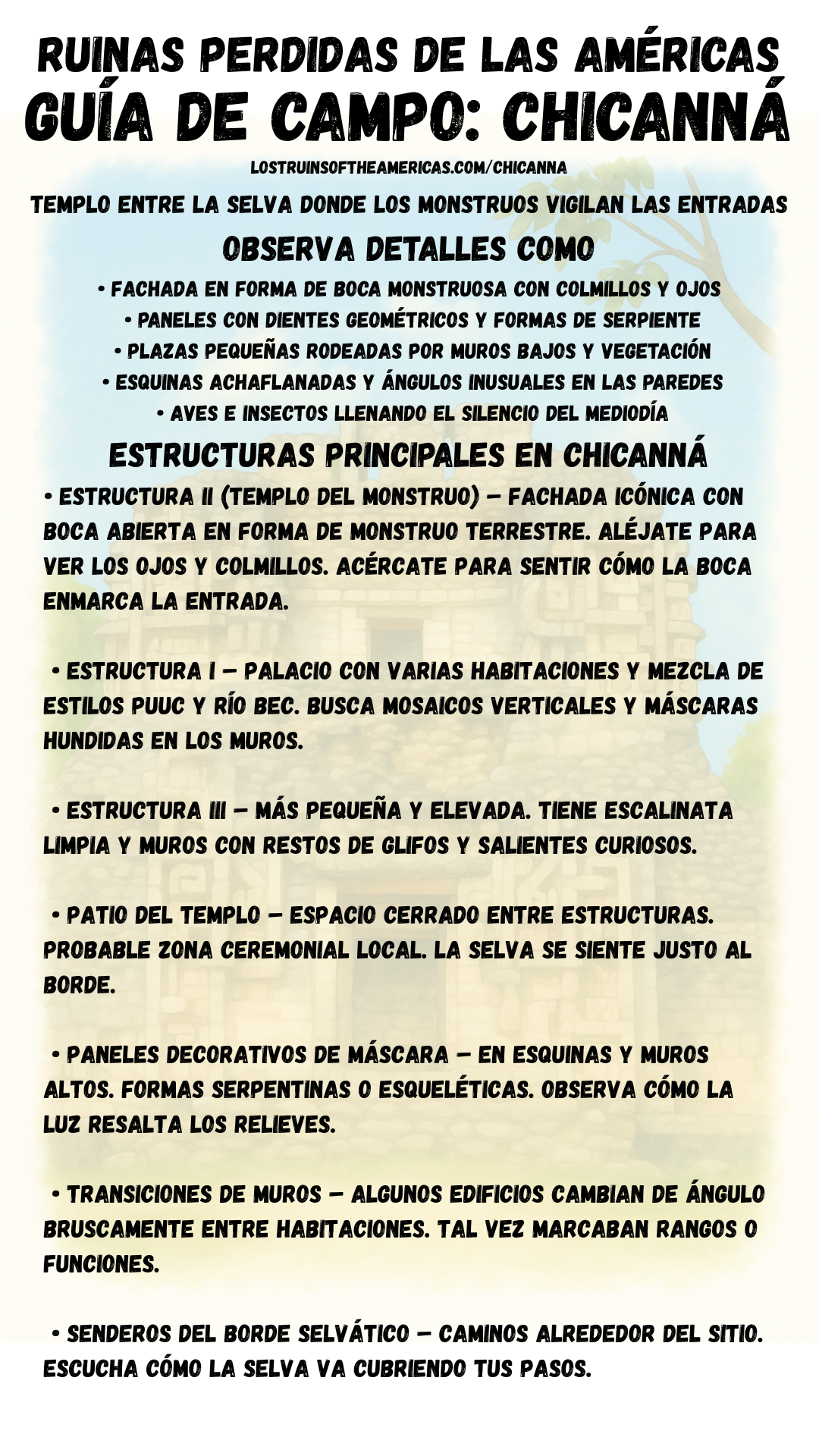
Download Quick Guide
Spanish
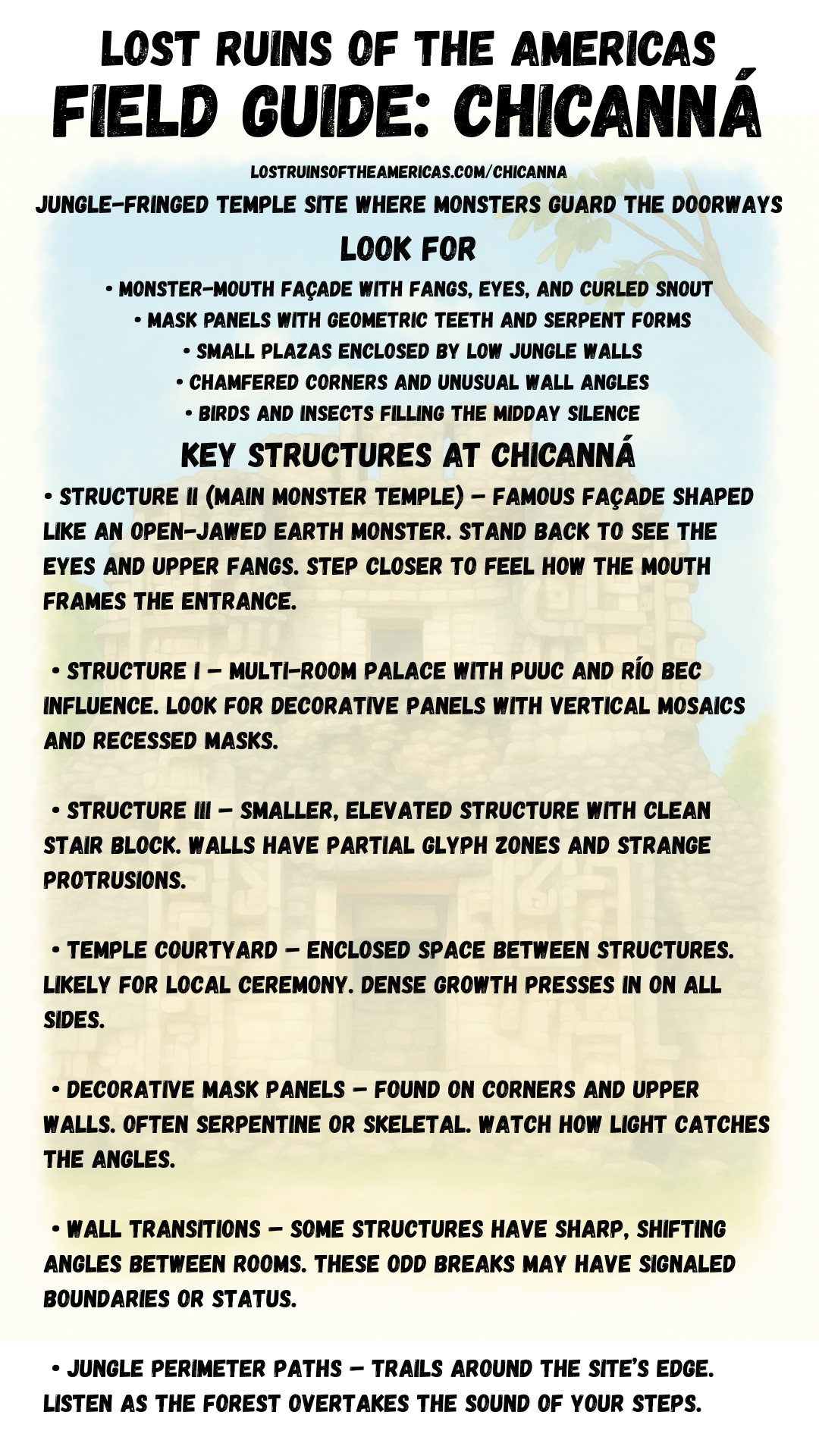
Download Quick Guide
English
Traveler Tips
- Base in Xpujil to visit Chicanná, Becán, and Xpuhil in a single loop.
- There are no vendors on site. Bring water, snacks, and sun protection.
- Paths are short and flat, so even a brief stop allows time to see the main structures.
- Visit in the morning or late afternoon for softer light on the monster mouth façade.
Elsewhere in the Americas…
While Chicanná rose in the forests of Campeche, major cultures across the Americas were shaping their own ceremonial worlds:


In the U.S. Southwest, Ancestral Puebloans built early communities at Mesa Verde.

Huaca de la Luna on the north coast continued Moche style ceremonies even as local power shifted.
Insider Explorer Advice
A taxi from Xpujil makes it easy to visit Chicanná, Becán, and the towers at Xpuhil, with the driver waiting at each stop so there is no concern about transport. The short distances make the circuit a smooth half day outing. At Chicanná, the standout is the carved monster mouth doorway, with teeth and eyes framing the entrance. Passing through it feels intentional, a designed shift into a more symbolic space. The rest of the site follows the clean lines of the Río Bec tradition, but the façade remains the defining feature.
Summary: Chicanná is a compact but striking Maya site, where a single carved doorway turns the act of entering into a passage between worlds.
.