
Mesa Verde
USA / COLORADO / ANCESTRAL PUEBLOAN
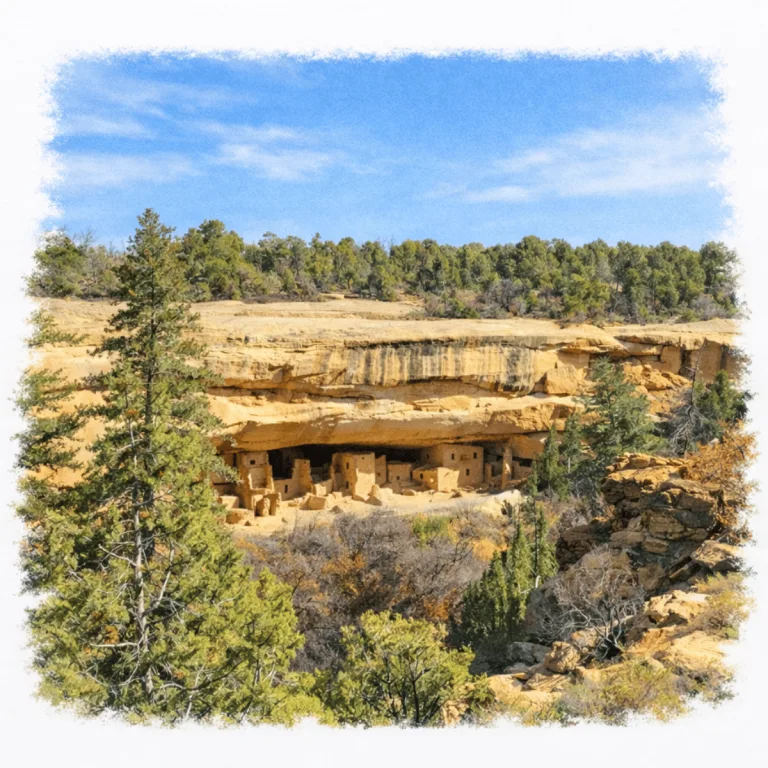
Along the cliffs of a high desert plateau in southwestern Colorado, Mesa Verde places masonry dwellings within rock alcoves, where multi-room structures sit directly beneath overhanging canyon walls.
| Name | Mesa Verde |
| Civilization | Ancestral Puebloan |
| Location | Southwestern Colorado, USA |
| Elevation | 6,000 to 8,572 ft (1,829 to 2,613 m) above sea level |
| Years Active | 550 to 1300 CE |
| Primary Resources | Sandstone, juniper timber, local clay |
| Site Type | Cliff dwellings and mesa top villages |
| Key Highlights | Cliff Palace, Balcony House, Long House, panoramic canyon views |
| UNESCO | World Heritage Site (1978) |
| Entry Fee | National Park entrance pass required |
| Best Time to Visit | Spring and fall; summer tours require advance booking |
| Field Visit | Visited and documented by Lost Ruins of the Americas |
Unique Features of Mesa Verde National Park
- Extensive Cliff Dwellings: Dozens of ancestral Puebloan structures set high in sheltered canyon alcoves.
- Cliff Palace: One of the largest and most iconic cliff dwellings in North America.
- Mesa Top Villages: Early pit houses and surface structures showing centuries of habitation.
- Preserved Architecture: Exceptional masonry, kivas, and multi story alcove construction.
- Dramatic Views: Panoramic canyon landscapes surrounding each major site.
Location & Access
- Nearest Town: Cortez, Colorado
- Directions: Mesa Verde National Park is accessed via Highway 160. After entering the park, a long scenic drive climbs onto the mesa top, with overlooks and trailheads branching from the main loop roads.
- National Monument Site: Mesa Verde National Park
- Opening Hours: Vary by season; most roads, dwellings, and visitor facilities close during winter.
- Entry Fees: National Park entrance pass; cliff dwelling tours require additional timed tickets.
- Facilities: Visitor centers, restrooms, café, museum, overlooks, and picnic areas.
- Accessibility: Many viewpoints are accessible; cliff dwelling tours often require ladders, stairs, and narrow passages.
- Pro Tip: Cliff Palace, Balcony House, and Long House require ranger guided tours with timed entry. During summer these often sell out, so reserve tickets well in advance.
Highlights to Help Understand Your Visit
A visit to Mesa Verde National Park is easier to appreciate when the landscape itself becomes part of the story.
- Cliff and Mesa as One System: The dwellings in the alcoves and the villages on the mesa top belong to the same community network. Seeing both helps explain how daily life shifted between open ground and sheltered stone.
- Alcove Selection Was Intentional: The shape and depth of each alcove guided the layout, light, and internal arrangement of the dwellings. Builders followed the rock first.
- Room Blocks Tell Social Patterns: Clusters of rectangular rooms wrap around open spaces. These groupings hint at family organization, storage priorities, and seasonal routines inside the canyon.
- Kivas as Community Anchors: The placement of kivas marks centers of ceremony and cooperation. Their distribution helps explain how work and belief were balanced.
- Movement Shapes Understanding: Many dwellings sit high above the canyon floor. Imagining the daily routes between mesa top fields and alcove homes reveals the connection between agriculture and shelter.
Key Structures of Mesa Verde
- Cliff Palace: The largest cliff dwelling in the region. More than 150 rooms and 20 kivas form a multi level community set deep within a sweeping sandstone alcove. Masonry blocks, plastered walls, and careful room clustering show advanced planning and social organization.
- Balcony House: A compact, defensively positioned dwelling reached by ladders and tight passages. Its narrow rooms, blocked doorways, and elevated placement illustrate a community focused on control of access and movement.
- Long House: A broad settlement on Wetherill Mesa. Terraces, storage rooms, and a long continuous plaza stretch across the alcove. The site shows a blend of domestic, agricultural, and ceremonial functions that served a large local population.
- Spruce Tree House: One of the best preserved cliff dwellings. Its closely packed rooms and kivas demonstrate efficient use of limited alcove space. Although access changes by season, it remains visible from overlooks near the museum.
- Sun Temple: A mesa top ceremonial structure built with finely shaped sandstone blocks. Its D shaped plan and thick walls suggest astronomical or ritual alignment. The layout shows a complex understanding of space and observation.
- Far View Sites: A cluster of mesa top villages with towers, reservoirs, and room blocks. These communities reveal the long occupation of the mesa before the shift into the cliff alcoves.
- Mesa Top Pit House Villages: Early dwellings built partly below ground. Their circular and rectangular forms represent the architectural transition that eventually led to above ground room blocks.
- Square Tower House: A tall multi story structure built against the back of an alcove. Its tower rises several levels and preserves some of the region’s most intricate masonry.
- Twin Towers Complex: A mesa top architectural pair located near the Far View group. The towers use fine stonework and may have served as observation, signaling, or ritual structures.
- Cliff Canyon Settlements: Smaller dwellings across the canyon walls. Their scattered placement shows how families and extended groups lived within shared territory but maintained distinct household spaces.
History and Legends
Mesa Verde preserves more than seven centuries of ancestral Puebloan history, beginning with early pit house settlements on the mesa top around 550 CE. Over time, communities expanded across the mesa in small villages, experimenting with new building styles, agricultural practices, and social organization. By the 1100s many groups began constructing their homes within the alcoves of the canyon walls, creating the cliff dwellings for which the region is now known. The reasons for this shift are still discussed, with possibilities including defense, climate variability, resource management, or cultural preference. Whatever the motivation, the result was a distinctive architectural tradition built into the curved stone shelters of the cliffs.
The cliff dwellings required careful planning. Builders shaped sandstone blocks, used local timber for beams, and constructed multi story arrangements of rooms and kivas that fit precisely within each alcove. Everyday life unfolded across interconnected spaces for storage, cooking, ceremony, and community activity. The placement of dwellings also offered natural protection from weather, catching sunlight in winter and providing shade in summer. From the canyon floor, the dwellings appear almost hidden, blending with the surrounding stone until the eye adjusts to their lines and openings.
Puebloan tradition holds deep connections to place, ancestors, and the layered world of earth and sky. While Mesa Verde lacks written records, the architectural layout of kivas, plazas, and oriented room blocks reflects beliefs tied to community balance and ceremonial life. Circular kivas served not only as functional spaces but also as symbolic centers linked to stories of emergence and connection with earlier generations. The cliff alcoves themselves carry a sense of protection and enclosure that likely reinforced ideas of belonging and continuity.
Mesa Verde was not a single unified city but a landscape of interconnected communities distributed across the mesas and canyons. By the late 1200s population patterns shifted again, and people gradually left the region, joining other Puebloan groups to the south. The departure was part of a wider movement across the Southwest, shaped by social, environmental, or cultural changes that affected many communities during this period.
European American interest in the area grew in the late nineteenth century, and formal excavation and preservation efforts began soon after. In 1906 Mesa Verde became one of the first National Parks established to protect cultural heritage. Today the site remains a place of living significance for modern Pueblo peoples, who consider these canyons and dwellings part of their ancestral landscape. Visitors who pause at the overlooks or walk through the guided tours encounter not only stone walls but generations of memory shaped by this dramatic setting.
Experiences Around Mesa Verde
The cliff dwellings are only part of the story. Southwestern Colorado opens into broad valleys, piñon and juniper country, and distant views of the San Juan Mountains.
–
Walk downtown Cortez along Main Street and Montezuma Avenue, with local shops and the Montezuma Heritage Museum for the stories of ranching, irrigation, mining, and early communities in the Four Corners.
–
McPhee Reservoir near Dolores adds boating, fishing, and shoreline trails through open mesa country, with broad views across the water toward the surrounding high desert.
How to Get There & Where to Go Next
How to Visit Mesa Verde
– Step-by-step access to the site –
- From Las Vegas: Drive northeast on I 15, then follow UT 9, US 89, and UT 12 toward US 160. Total distance is about 520 miles, roughly 8 hours of driving.
- • Gateway Town: Cortez, Colorado, is the closest base for supplies, food, and lodging.
- • Final Stretch: From Cortez, follow US 160 east for about 10 miles to reach the entrance of Mesa Verde National Park.
- • On Site: The main road climbs onto the mesa top and branches toward overlooks, museums, and trailheads. Timed tickets are required for Cliff Palace, Balcony House, and Long House.
Tips: Buy tour tickets ahead of time during summer. Plan for long internal drives and bring water, since facilities are spaced out across the mesa.
Nearby Ruins You Can Visit
In the sandstone canyons of the Four Corners, these nearby ancestral sites reveal the shared traditions and regional connections of the ancient Pueblo world.

Chimney Rock – Perched high above the valley, this lunar aligned outpost marked a far flung Chacoan frontier tied to celestial events.

Hovenweep – Towering sandstone structures perched on canyon rims reveal the same precision and planning seen at Chimney Rock.

Lowry Pueblo – A compact village with a Great Kiva, showing how community and ceremony blended in Chaco’s northern sphere.
Traveler Tips
- Begin at the museum and visitor center for maps and historical context
- The loop trail is mostly level, but some sections may require stepping over rocks
- Carry water. None is available on the trail
- Campground is first-come, first-served and makes a great base for exploring
- Spring and fall provide the best weather. Summer can be very hot with no shade
Elsewhere in the Americas…
While the towers of Hovenweep rose along the canyon rims of the Four Corners, other civilizations across the Americas were reaching their own cultural heights.

In Mexico, Chichén Itzá flourished as a major Maya city where pyramids and observatories aligned with celestial cycles.


Kuélap stood high in northern Peru as a walled Chachapoya stronghold with massive stone walls and mountain views.
Insider Explorer Advice
Tour tickets for Cliff Palace, Balcony House, and Long House can be easy to obtain in the slow season, but during busy months they often sell out. Each dwelling requires its own timed ranger guided entry, so summer visitors should reserve well in advance. Everything else in the park is self guided, and the rangers do an excellent job of keeping groups engaged and informed. The park is much larger than expected. The top of the mesa includes forests, open areas, and even a small lake, with views stretching across deep canyons. It is a good place to spend the day. Visitors can eat at the café or enjoy a picnic, and Cortez makes a convenient base for stocking up on supplies and exploring the area.
Summary: Mesa Verde is a vast ancestral landscape where cliff dwellings, mesa top villages, and canyon views reveal centuries of Puebloan history shaped into stone and shelter.