
Túcume
PERU / LAMBAYEQUE / SICÁN
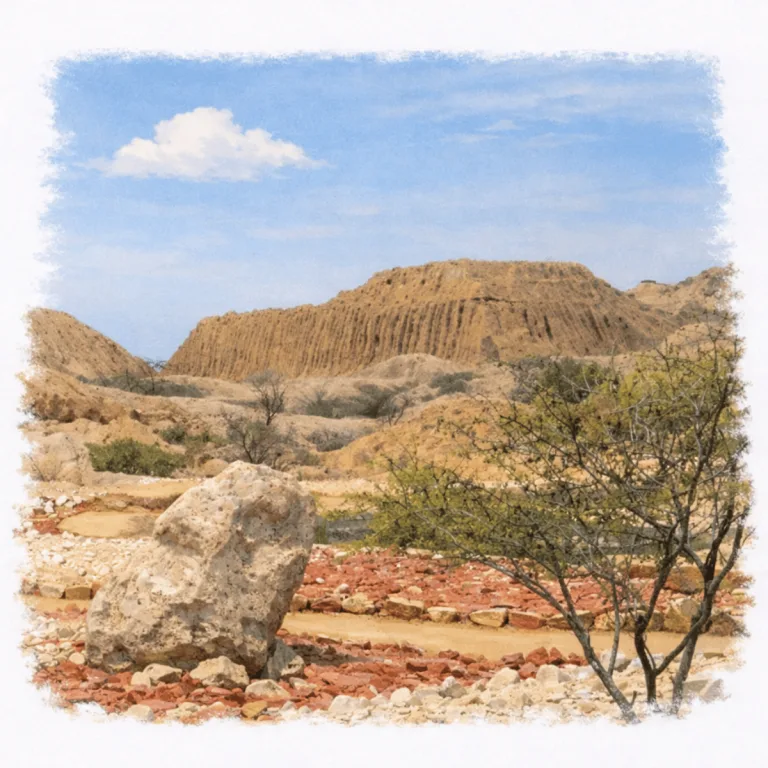
Across a wide desert plain beneath Cerro La Raya, Túcume spreads a landscape of adobe pyramids, where more than two dozen huacas form one of the largest ceremonial complexes of the Sicán / Lambayeque culture.
| Name | Túcume |
| Civilization | Sicán / Lambayeque |
| Location | La Leche Valley, Túcume District, Lambayeque, Peru |
| Elevation | 43 to 103 m (141 to 338 ft) above sea level. |
| Years Active | 1000 – 1470 CE |
| Primary Resources | Adobe, cotton, marine goods |
| Site Type | Elite urban, political, and ceremonial center |
| Key Highlights | 26 pyramids, panoramic lookout, Huaca Larga, Templo de la Piedra Sagrada |
| INT Airport | Cpt FAP José Abelardo Quiñones Gonzales INT Airport (CIX), Chiclayo |
| Entry Fee | S/8 Routes A or B; S/12 integral route |
| Best Time to Visit | Year-round, early morning |
| Field Visit | Visited & photographed by Lost Ruins of the Americas |
Unique Features of the Túcume Archaeological Site
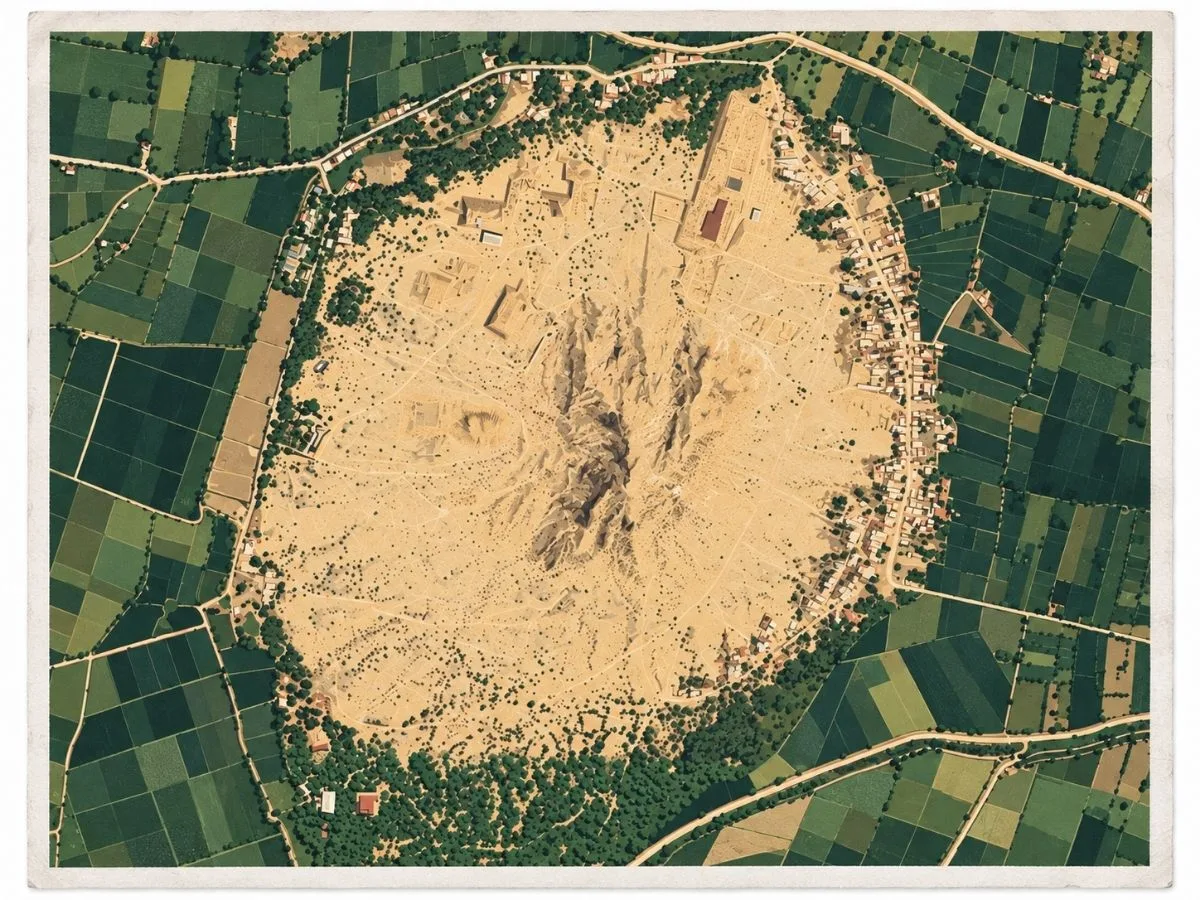
- Massive Scale: The site spans over 220 hectares with more than two dozen monumental adobe pyramids.
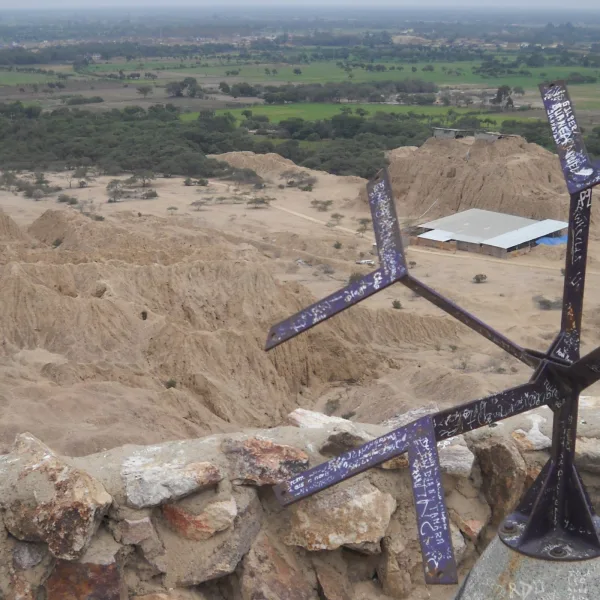
- Panoramic Lookout: Hilltop view gives an unmatched perspective of the site’s expanse and layout.
- Adobe Engineering: Thousands of vertically stacked adobe bricks used to create ceremonial mounds across the valley.
- Rural Backdrop: The contrast of arid land, green farmland, and distant ridges makes Túcume one of the most visually striking sites in northern Peru.
Location & Access
- Nearest Town: Túcume, Lambayeque
- Directions: Take a colectivo from Chiclayo or Lambayeque to Túcume town. From there, it’s a short mototaxi ride to the ruins entrance.
- Official Website: Ministry of Culture, Museo de Sitio Túcume.
- Opening Hours: Tuesday to Sunday, 9:00 AM to 4:30 PM. Closed Mondays except announced holiday openings.
- Entry Fees: S/8 for adults on Route A or B; S/12 for the integral route.
- Facilities: Site museum, restrooms, parking, shop, and marked archaeological routes.
- Accessibility: Partial. Ramps and two wheelchairs are available, but the archaeological routes include uneven outdoor terrain.
- Pro Tip: Begin with the museum before walking the archaeological circuit. Its models clarify the scale and relationship of the pyramids surrounding Cerro La Raya.
Highlights to Help Understand Your Visit
These pyramids weren’t just built for height. They shaped spiritual movement, elite control, and ceremonial time across centuries.
- Layered Occupation: Túcume evolved through three civilizations, Lambayeque, Chimú, and Inca, each modifying the same sacred space.
- Built Around the Hill: Cerro Purgatorio wasn’t incidental. It was the spiritual axis. Most pyramids are arranged in relation to it.
- Not a Plaza-Centered City: Unlike Inca sites, Túcume’s layout is decentralized. This was a sacred landscape, not an urban grid.
- Marine Symbolism Everywhere: Notice the boats, waves, and aquatic patterns in friezes, as the Lambayeque saw water as life, death, and journey.
- Adobes Speak of Labor: Millions of handmade bricks, often with fingerprints, show how communal labor shaped power and ritual visibility.
- Viewpoints With Meaning: Climb to the lookout not just for the view. It mirrors how elites once oversaw both ritual space and farmland.
Key Structures of the Túcume Ruins
- Huaca Larga: The largest pyramid at Túcume and one of the longest in the Americas. Likely served as an elite residence and ceremonial stage, over 700 meters long and 20 meters high.
- Huaca Las Balsas: Decorated with vibrant iconography of boats, birds, and marine symbols. Interpreted as a ritual space tied to water deities and cosmological journeys.
- Huaca 1 and Huaca 2: Adjacent pyramids built with thick layers of adobe; their placement suggests political or religious symbiosis within the central complex.
- Huaca del Pueblo: Smaller but strategically placed; believed to be a public-access ceremonial structure or residence for mid-level elites.
- Central Plaza: A wide open ceremonial space bordered by multiple huacas. It likely served as the gathering zone for rituals, offerings, and processions.
- Cerro La Raya: A lesser-known hill within the site boundary, associated with later Chimú modifications and astronomical alignments.
- Cerro Purgatorio (Lookout Hill): The sacred hill at the heart of Túcume. Now a maintained viewpoint, it was once a revered spiritual landmark anchoring the city’s cosmic layout.
- Canal System: Remnants of ancient irrigation channels connecting the pyramids to nearby fields. Evidence of landscape engineering and water control.
- Túcume Site Museum: Features burial reconstructions, ceramics, textile remnants, and scale models. Offers an overview of the site’s development across centuries.
History and Legends
Túcume grew into a major Sicán center after about AD 1100, when builders began raising the great adobe monuments that still surround Cerro La Raya, also known as Cerro Purgatorio. Across the plain they constructed 26 monumental pyramids, along with smaller platforms, courtyards, workshops, storerooms, and residential compounds. The buildings went up in stages, with long ramps climbing their sides and new walls repeatedly covering older ones. By the later Sicán period, Túcume had become one of the largest centers on Peru’s north coast, set within the irrigated fields of the lower La Leche Valley.
The pyramids did not all serve the same purpose. Huaca I remained an important center of local authority, reached by a long ramp climbing toward rooms and enclosed spaces at its summit. Nearby, Huaca Larga eventually became the largest building at Túcume, stretching roughly 700 meters along the northern side of Cerro La Raya. Other compounds contained workshops, storerooms, courtyards, and ceremonial spaces. As generations rebuilt the site, rooms were sealed, ramps altered, and new structures raised over earlier ones, leaving several centuries of construction packed into the same adobe monuments.
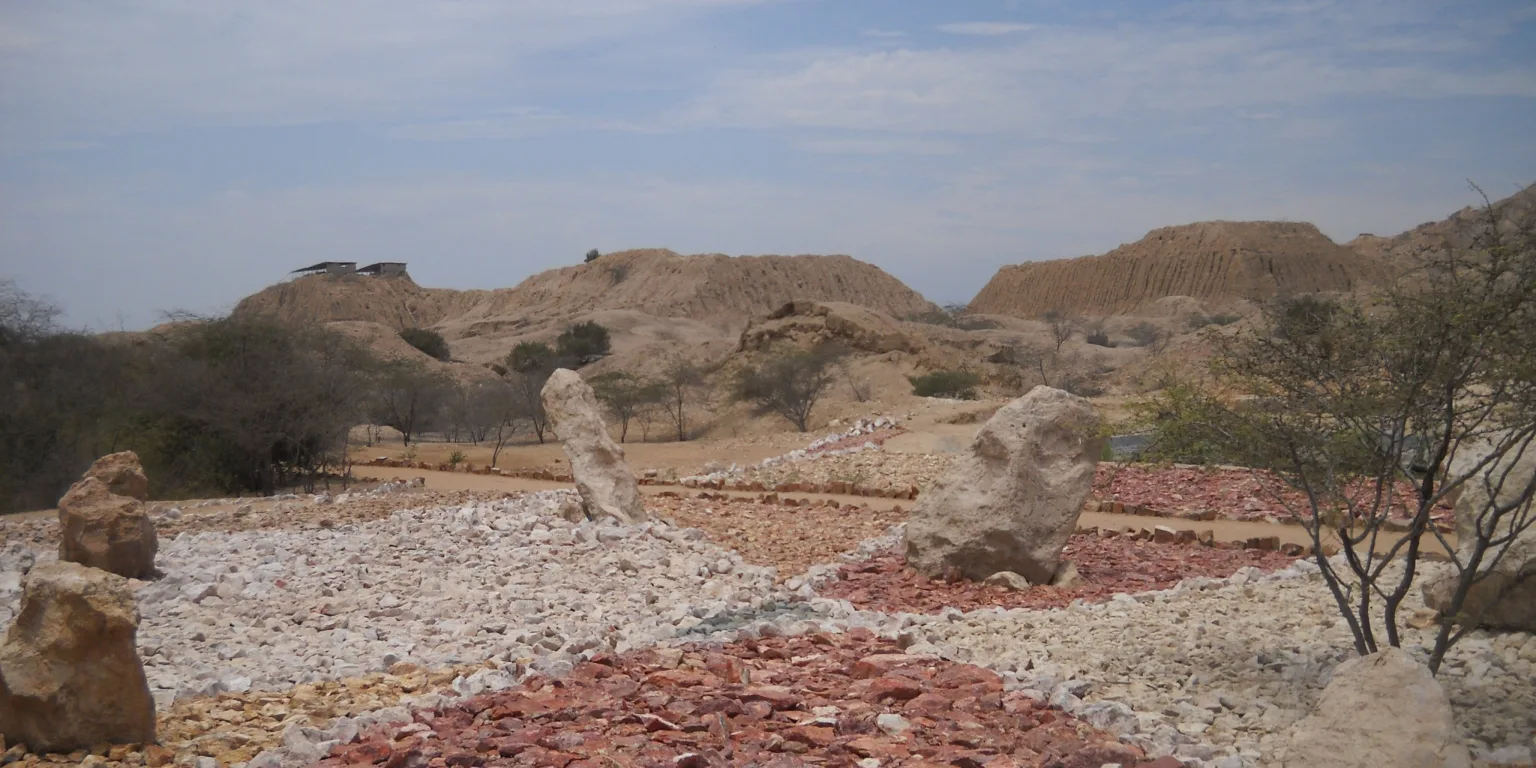
Túcume survived two major changes of rule. The Chimú conquered the region in the late 14th century, but they continued to use much of the Sicán center and added their own architecture and decoration. Around 1470, the Inca incorporated Túcume into their empire and occupied several of the same important compounds. Excavations at Huaca Las Abejas have uncovered dozens of elite burials from the Inca period, while the Temple of the Sacred Stone continued to receive offerings under successive rulers. Around the upright stone at its center, archaeologists found human and llama sacrifices, Spondylus shell, and hundreds of miniature metal objects.
One of the most important traditions associated with the Sicán world was recorded at Túcume after the Spanish conquest. In 1586, Miguel Cabello de Balboa wrote down a story told by Don Martín Farrochumbi, an Indigenous nobleman of Túcume, about Naylamp, a ruler who arrived on the Lambayeque coast by sea with his followers and founded a new dynasty. The account cannot be used as a literal record of Túcume’s founding, but it preserves a tradition deeply connected with Sicán identity. At Huaca Las Balsas, mud reliefs of boats, waves, seabirds, marine animals, and human figures have been linked by researchers at Túcume with the same maritime world that appears in the Naylamp story.
The Spanish conquest brought the long occupation of Túcume to an end. After 1532, Inca administration collapsed and the great compounds were abandoned within the following years. At Huaca Larga, parts of the complex were deliberately filled and burned during this final phase, and early colonial glass ornaments found in the deposits help place the event after the conquest. When Pedro Cieza de León traveled through the valley in 1547, he found Túcume’s great structures already in ruins. By then the pyramids around Cerro La Raya had passed from Sicán to Chimú and then Inca control, with each period leaving its own walls, burials, offerings, and rebuilding inside the same monumental center.
Experiences Around Túcume
The ruins are only part of the story. Túcume sits in the lower La Leche Valley, where irrigated fields and algarrobo trees break up the dry northern coastal plain.
Nearby workshops in La Raya keep native-cotton weaving alive, with waist looms and natural dyes made from cochineal, achiote, and local plants.
On the road toward Lambayeque, tour the San Roque factory to see how King Kong is layered with biscuit, manjar blanco, pineapple, and peanut filling..
How to Get There & Where to Go Next
How to Visit Túcume
– Step-by-step access to the site –
- Fly from Lima to Chiclayo – Daily flights take around 1.5 hours.
- Colectivo to Túcume town – From central Chiclayo or Lambayeque; allow 45 minutes.
- Mototaxi to site entrance – A quick 5–10 minute ride from Túcume town center.
- Optional walk to lookout point – Trail to Cerro Purgatorio takes 20–30 minutes uphill.
Tips: Go early to avoid heat on the trail. The museum near the entrance is included in admission and worth seeing first.
Nearby Ruins You Can Visit
These nearby ruins share Túcume’s sacred landscape. From royal tombs to ritual centers lost in cane fields, each reveals a different face of Lambayeque power.
Sipán (Huaca Rajada) – Royal tombs of a Moche lord discovered intact, with burial treasures unmatched in the Americas.

Ingapirca – Ecuador’s best-known Inca site, where an elliptical Temple of the Sun rises above older Cañari ceremonial foundations.

Batán Grande – A massive late-Moche center with signs of collapse, fire, and mystery beneath the surface.
Traveler Tips
- Visit early or late in the day, mid-day sun is intense and shade is limited.
- The trail to the lookout point is worth the climb but requires stable footwear.
- Pack water, snacks, and sun protection; vendors may not be present outside peak hours.
- Combine your visit with nearby sites like Sipán or Batan Grande for a full day tour.
- Allow time for the museum before entering the main site, it adds key context.
Elsewhere in the Americas…
At Túcume, clusters of pyramids and ceremonial spaces shaped life on Peru’s north coast, while other cultures across the Americas developed in different ways:


Ancestral Puebloans at Lowry Pueblo and Hovenweep raised stone villages and gathered in Great Kivas on the Colorado Plateau.

In central Mexico, Cantona developed fortified terraces, causeways, and urban compounds tied to regional control.
Insider Explorer Advice
Use Chiclayo as your hub and head to the Museo Tumbas Reales de Sipán first. Outside, mototaxi drivers wait, negotiate the price before you get in, and be clear you’re doing a full-day circuit: Sipán, Túcume, Ventarrón, Batan Grande if time allows. A knowledgeable driver can make the route seamless, cutting through desert backroads and green cane fields. Túcume is the visual climax, a massive adobe city best understood from the hill above. Pack extra water and lunch for two, and treat the driver well. A good arrangement turns transport into guidance.

Summary: Túcume is a city of pyramids stretched across sand and memory. Still vast, still sacred, still watching the valley it once ruled.