
Balamkú
MEXICO / CAMPECHE / MAYA
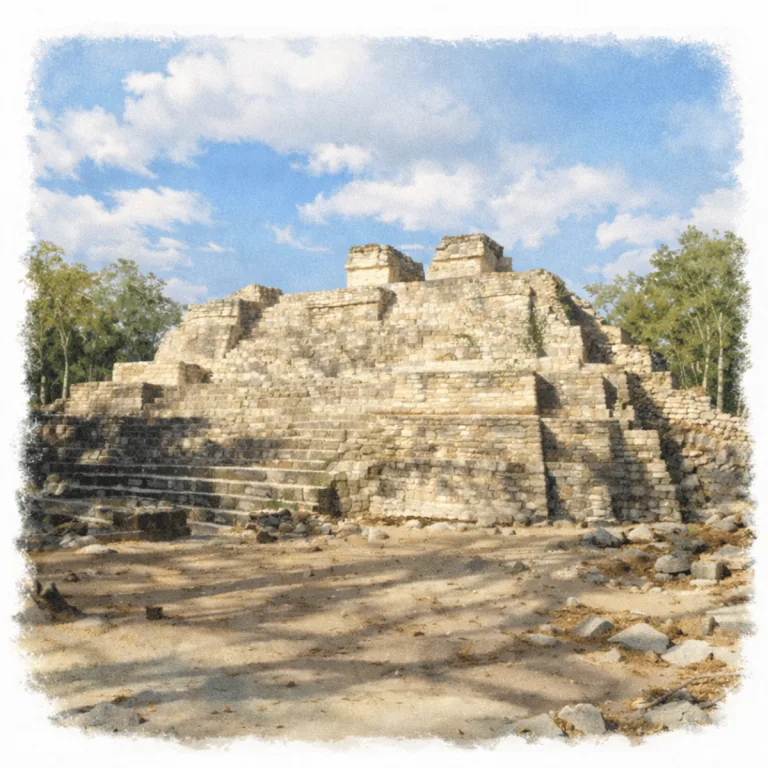
Deep within the Campeche rainforest, Balamkú centers on a vaulted chamber lined with modeled stucco friezes, where towering deities and cosmological scenes form one of the most elaborate preserved façades in the Maya world.
| Name | Balamkú |
| Civilization | Maya |
| Location | Campeche, Mexico |
| Elevation | 200 meters (about 656 feet) |
| Years Active | c. 300 – 900 CE |
| Primary Resources | Limestone, lime stucco, mineral pigments, forest products. |
| Site Type | Ceremonial and civic center |
| Key Highlights | Original stucco frieze, preserved red pigment, jaguar imagery |
| UNESCO | Calakmul Biosphere Reserve |
| Entry Fee | 80 MXN; 145 MXN for foreign visitors. |
| Best Time to Visit | Morning, en route to or from Calakmul |
| Field Visit | Visited and documented by Lost Ruins of the Americas |
Unique Features of the Balamkú Archaeological Site
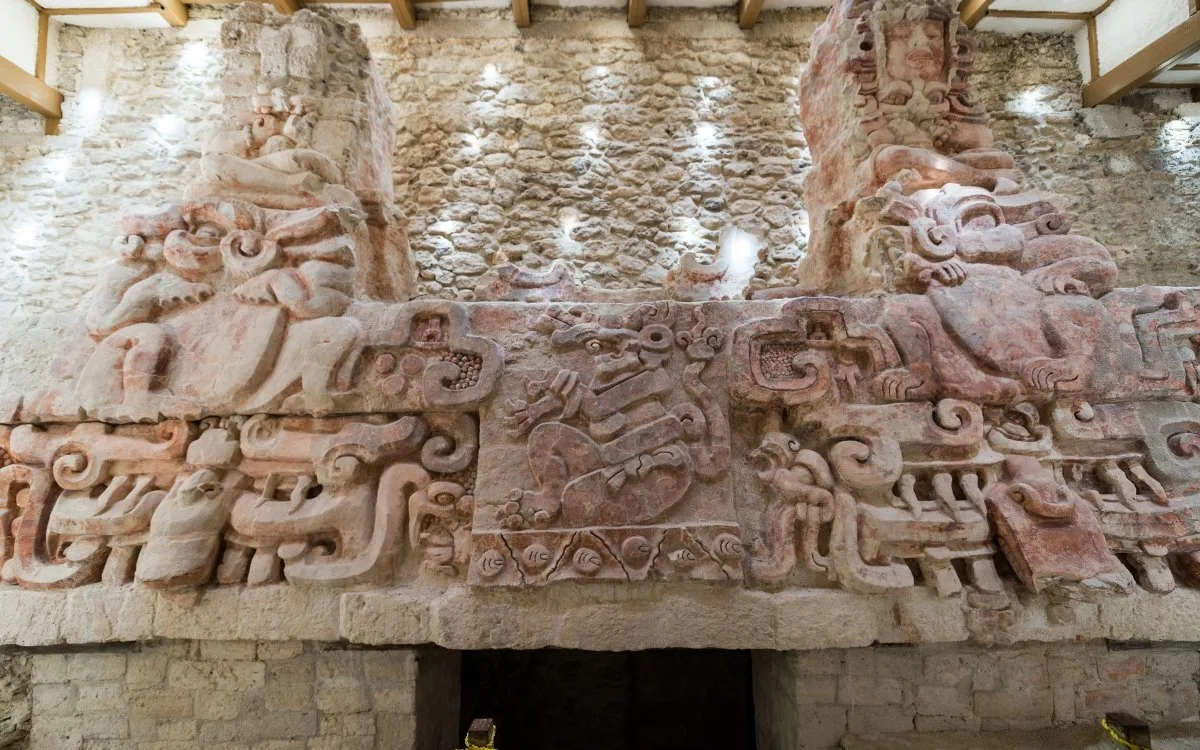
- Stucco Frieze: A rare intact frieze with polychrome paint preserved in Structure I. Depicts cosmological masks and jaguar deities.
- Original Paint: Red and ochre pigments still cling to the surface of the sculpted figures.
- Intimate Access: Visitors can view the frieze at close range by request, with staff unlocking the chamber door.
- Forest Paths: Quiet jungle trails connect several small plazas and temples in a shaded setting.
- Low Visitor Flow: Often overlooked, Balamkú offers a peaceful and unhurried ruin experience.
Location & Access
- Nearest Town: Xpujil
- Directions: From Xpujil, drive west on Federal Highway 186 to kilometer 93, opposite Conhuás, then follow the access road for 2.7 kilometers.
- Official Website: INAH Zona Arqueológica de Balamkú.
- Opening Hours: Monday through Sunday, 8:00 AM to 5:00 PM. Last entry is at 4:45 PM.
- Entry Fees: 80 MXN for Mexican visitors and foreign residents; 145 MXN for foreign visitors.
- Facilities: Parking, restrooms, and an information module.
- Accessibility: Moderate, with forest paths, uneven stone surfaces, and steps around the restored buildings.
- Pro Tip: Use the Balamkú turnoff at kilometer 93 opposite Conhuás, not the separate Calakmul reserve entrance farther west
Highlights to Help Understand Your Visit
A few key ideas will help frame what you see at Balamkú and why this small site holds rare importance in the region.
- A Living Monument: The stucco frieze inside Structure I is original Maya artwork preserved in place. Its scale and detail show how brightly painted temple façades once transformed ceremonial buildings.
- Cosmology in Motion: The frieze layers cosmic creatures, ruling figures, and earth symbols into a single narrative band. It illustrates how authority, mythology, and kingship were visually fused in temple design.
- Red Paint as Meaning: Traces of pigment across the masks and panels reveal that color was not decoration. It signaled life, sacrifice, and divine presence within ceremonial spaces.
- A Compact Ceremonial Core: The small plazas and modest pyramids show a community oriented around ritual rather than monumental scale. Movement across the site follows short paths that link focused ceremonial zones.
- Southern Connections: Architectural details and artistic style connect Balamkú to southern Maya regions during the Early Classic. These ties suggest a network of shared ideas that traveled faster than population growth.
Key Structures of the Balamkú Ruins
- Structure I: The principal temple of the site, notable for its enclosed chamber protecting the monumental stucco frieze. The exterior shows typical Maya masonry, while the interior preserves rare Preclassic and Early Classic artistry.
- Frieze Room: Inside Structure I, this gallery contains an extraordinary 16-meter-long stucco frieze depicting jaguars, rulers, cosmic monsters, and symbols of rebirth. Portions of red, blue, and ochre pigment remain, offering a vivid glimpse of how Maya temples once looked.
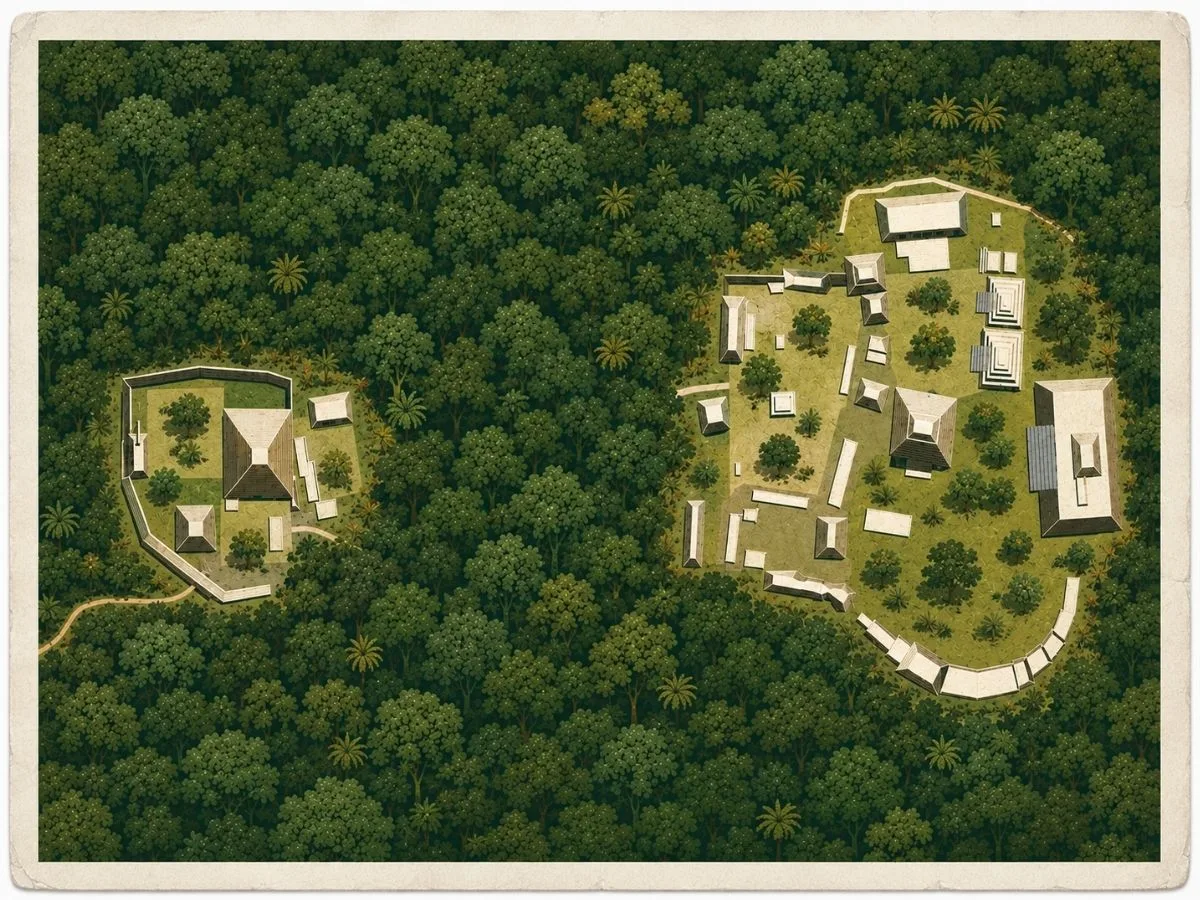
- Plaza A (Central Group): The main plaza is framed by temple platforms and low pyramids, serving as a civic and ceremonial core. Its open arrangement makes it a natural gathering space within the site.
- Structure IV: A step-pyramid positioned on the northern side of the Central Group. Though modest in size, it anchors the plaza’s ceremonial orientation and offers perspective on Balamkú’s architectural scale.
- South Group Plazas: A cluster of plazas (A–D) surrounded by smaller temples and range-type buildings. These areas show the residential and administrative side of the city, contrasting with the ceremonial core.
- Path Network: A compact trail system links the Central and South Groups. Signage along the way highlights key features, while shaded forest cover creates a calm, intimate atmosphere for visitors.
History and Legends
Balamkú, meaning “Temple of the Jaguar,” is one of the most artistically unique Maya sites in the Río Bec region. First settled around 300 CE, it remained active through the Classic period and formed part of a broader cultural corridor that included Becán, Calakmul, and Xpuhil. Despite its modest footprint, Balamkú holds one of the best-preserved stucco friezes in the Maya world.
The frieze inside Structure I is its crown jewel. Discovered in 1990, it had remained sealed and undisturbed for centuries. Measuring over 16 meters long, the frieze depicts underworld deities, celestial monsters, and jaguar imagery associated with power and rebirth. Its paint is original. Reds and ochres still cling to the plaster, offering a glimpse into the polychrome grandeur once common throughout Maya temples. The frieze’s preservation owes much to the chamber’s enclosure and lack of direct exposure.
Archaeological work has focused on conservation rather than excavation, and most of the site’s layout remains forested. The surrounding plazas and smaller temples show architectural similarities to neighboring cities but lack monumental scale. Their purpose appears residential and ceremonial, serving a community with strong ties to regional centers like Calakmul and Becán.
For visitors today, Balamkú offers rare intimacy with ancient Maya artwork. Unlike museum replicas or distant viewing platforms, the frieze here is the original. And it is viewed close enough to feel. A guardian still holds the key. Step inside, and the painted stone speaks in silence.
How to Get There & Where to Go Next
How to Visit Balamkú
– Step-by-step access to the site –
- Cancún to Xpujil Station Board the Tren Maya southbound toward Escárcega. Travel time is about 5 to 6 hours.
- Station to Xpujil Town Take a local taxi along Highway 186 for 10 to 15 minutes into town.
- Xpujil to Balamkú Hire a taxi for a direct ride to the site. Travel time is about 25 to 30 minutes west along Highway 186.
- Driving from Cancún Take Highway 307 south to Felipe Carrillo Puerto, then merge onto Highway 186 toward Xpujil. Expect 5 to 6 hours depending on stops.
Tips: Hire one taxi in Xpujil to cover Balamkú and the nearby Río Bec sites for a smooth and efficient visit.
Nearby Ruins You Can Visit
These sites share Balamkú’s forested setting, regional connections, and architectural experiments within the Río Bec cultural landscape.

Becán – A fortified center with deep defensive moats and impressive structures that defined regional power.

Chicanná – A small ceremonial residence where a carved zoomorphic doorway defines the site’s symbolic design.

Xpuhil – Slender tri-tower façades and ornate stonework capture the distinct visual style of the Río Bec region.
Traveler Tips
- Plan Balamkú as a stop along your route to Calakmul or Chicanná. A short visit is enough to see the entire site.
- Bring your own water. There are no vendors on site.
- The forest paths are shaded but can be humid. Wear light clothing and insect repellent.
- The stucco chamber is usually locked. Ask the caretaker if it can be opened for viewing.
- Allow time to quietly study the frieze. Photography may be permitted but check with staff first.
Elsewhere in the Americas…
While Balamkú developed its ceremonial spaces in the Maya lowlands, other major cultures in Americas were shaping their own landscapes of power and belief.

On Peru’s north coast, the Moche were building adobe temples such as Huaca del Sol and developing advanced irrigation and ceramic traditions.

San Agustín in Colombia reached its final phase of sculptural activity, with tomb guardians and enigmatic statues still added to sacred sites.

In the Mississippi Valley, Cahokia Mounds rose as a major Mississippian center, with earthen pyramids shaping a complex urban layout.
Insider Explorer Advice
Balamkú rewards quiet moments. The caretaker can unlock the frieze room, and once your eyes adjust, the masks and jaguar forms seem to rise out of the dim light. The pigment is original. Nothing here is a replica. It feels alive in a way few sites do. Visiting early helps keep that stillness intact. Most travelers hire one taxi in Xpujil to reach Balamkú along with Becán, Chicanná, and Xpuhil. It keeps the day smooth and lets you linger here before heading on.
Summary: Balamkú is a small site with a monumental treasure. Its frieze is not just rare. It is unforgettable.
.