
Ek Balam
MEXICO / YUCATÁN / MAYA
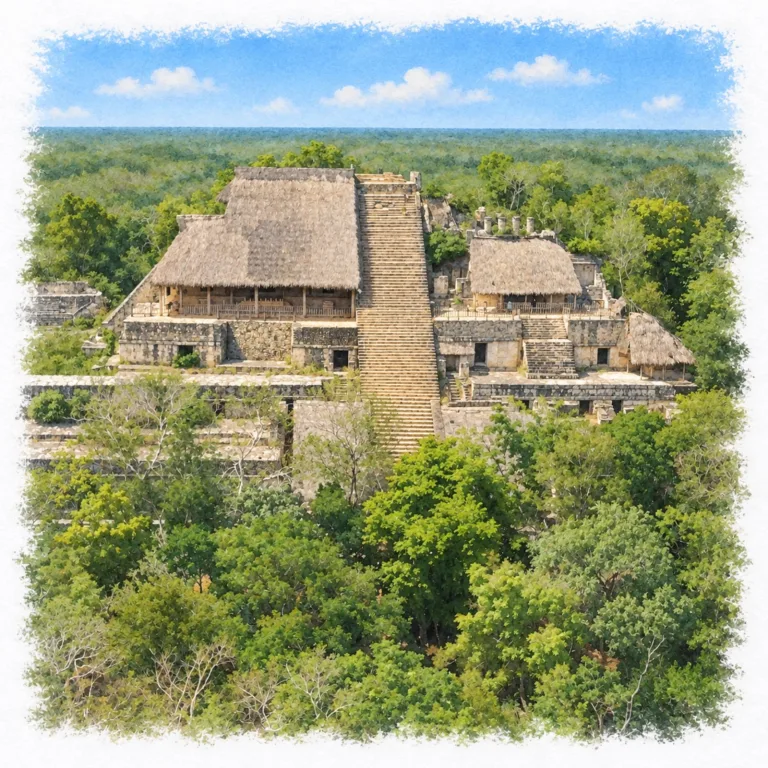
In the forests of northern Yucatán, Ek Balam preserves a walled Maya capital, where an elaborate stucco facade frames a royal tomb within the open jaws of an Earth Monster.
| Name | Ek Balam |
| Civilization | Maya |
| Location | Temozón Municipality, Yucatán, Mexico |
| Elevation | Approx. 28 m (92 ft) |
| Years Active | c. 600 BCE to 16th century; peak c. 770 to 896 CE |
| Primary Resources | Limestone, lime, sascab, and regional luxury trade goods |
| Site Type | Walled Maya dynastic capital and royal ceremonial center |
| Key Highlights | Acropolis, Sak Xok Naah façade, Oval Palace, Las Gemelas, vaulted passage |
| INT Airport | Cancún International Airport (CUN) |
| Entry Fee | 691 MXN foreign adults; 237 MXN Mexican adults |
| Best Time to Visit | Early morning, especially in the drier months |
| Field Visit | Visited & documented by Lost Ruins of the Americas |
Unique Features of the Ek Balam Archaeological Site
- Sak Xok Naah: Royal tomb fronted by an enormous Earth Monster stucco façade.
- Three Defensive Walls: Stone barriers enclosed and protected the royal precinct.
- Five Sacbeob: Raised roads linked the walled center with the surrounding settlement.
- Painter-Scribe Tradition: Painted vault caps preserve an unusually rich record of Maya calligraphy.
Location & Access
- Nearest Town: Valladolid, Yucatán, about 30 km south of the archaeological zone.
- Directions: From Valladolid, follow the signed route north toward Temozón and Ek Balam; the drive takes roughly 30 minutes.
- Official Site Authority: INAH Zona Arqueológica de Ek Balam
- Opening Hours: Daily, 8:00 AM to 5:00 PM; last entry at 4:00 PM.
- Entry Fees: 691 MXN for foreign adults and 237 MXN for Mexican adults under current federal and CULTUR charges; Yucatán residents are exempt from the CULTUR portion. Parking is 100 MXN.
- Facilities: Parking, restrooms, guided tours, and access to the site museum.
- Accessibility: Main plazas are mostly level but uneven; the Acropolis stairways are steep and limit upper access.
- Pro Tip: Arrive near opening to see the core before the strongest heat and well before the 4:00 PM last-entry cutoff.
Highlights to Help Understand Your Visit
Ek Balam becomes clearer when the visitor watches how movement, scale, and decoration change toward the royal center.
- Controlled Entry: Structure 18 and the surrounding walls narrow movement into the walled precinct, showing how access to the elite center was deliberately controlled.
- South to North Shift: The South Plaza gives way to the larger North Plaza, where the Acropolis and neighboring structures concentrate the heaviest monumental architecture.
- A Palace in Layers: The Acropolis is not a single temple pyramid, but a royal complex built through successive stages of rooms, corridors, stairways, and terraces.
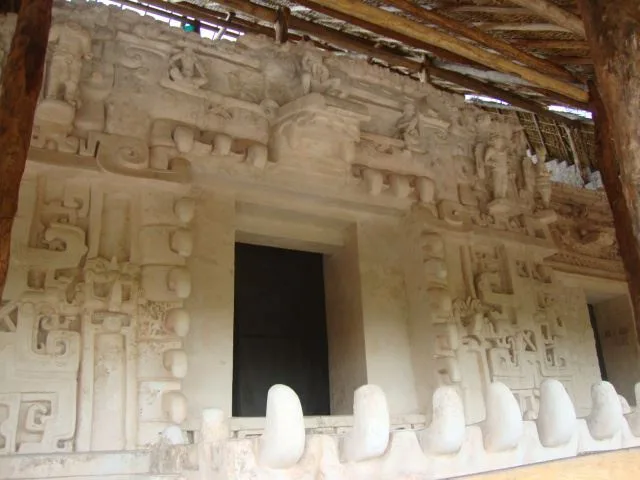
- Burial Built into Architecture: Sak Xok Naah places the tomb of Ukit Kan Lek Tok’ behind the open jaws of the Earth Monster, making royal burial part of the building itself.
- Power Written Across the Acropolis: Painted vault caps, glyphs, murals, and stucco sculpture preserve rulers, dates, ritual imagery, and dynastic authority throughout the palace.
Key Structures of Ek Balam
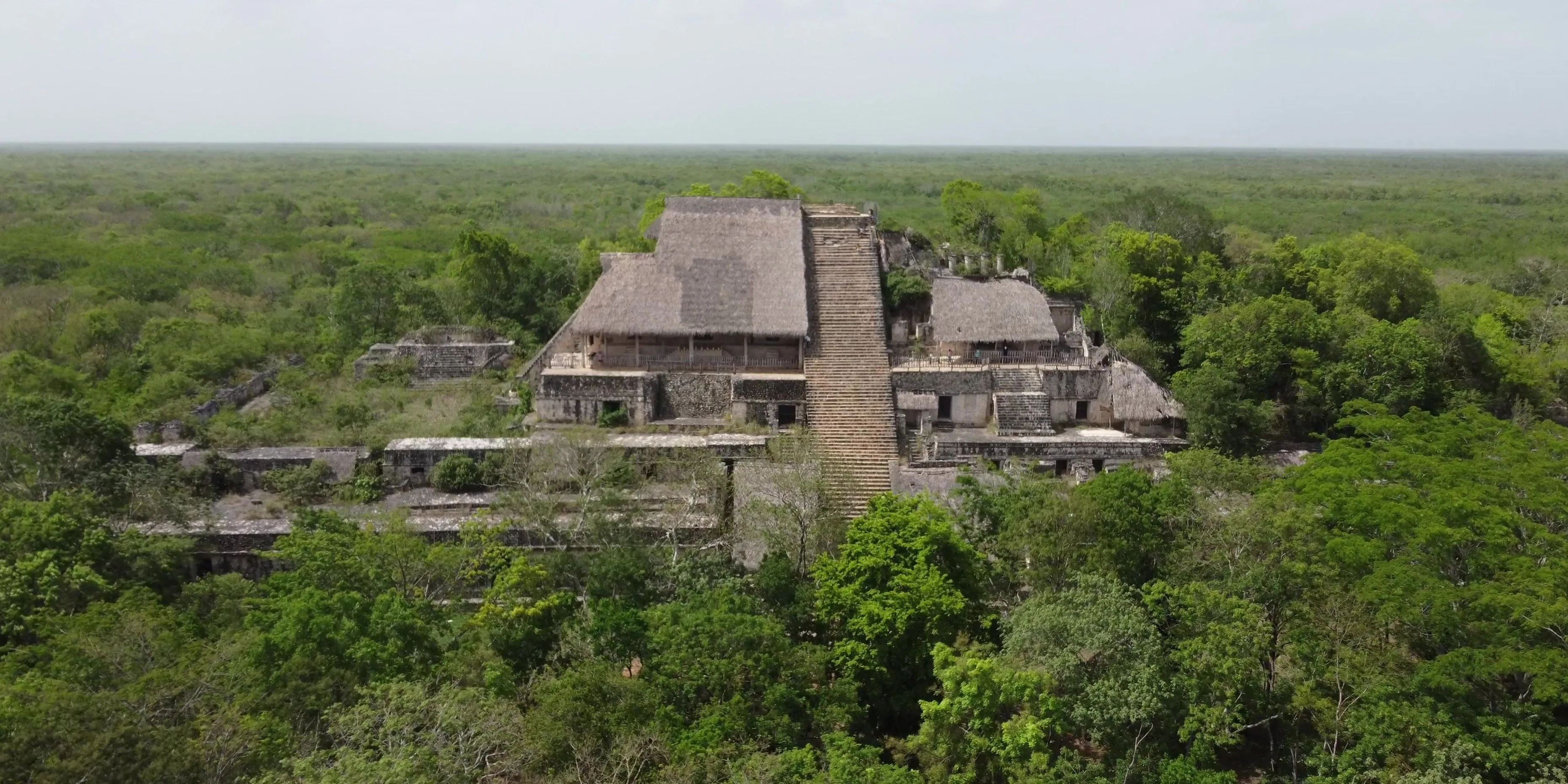
- The Acropolis (Structure 1): The dominant building at Ek Balam is a vast royal palace rising six levels above the North Plaza. Measuring about 160 meters long and 32 meters high, it contains stairways, vaulted rooms, interior passages, painted surfaces, and successive building phases. More than 70 rooms have been documented in only part of the complex, showing that the Acropolis functioned as far more than a single temple or pyramid.
- Sak Xok Naah (Room 35): Built into the fourth level of the Acropolis, Sak Xok Naah contained the tomb of the ruler Ukit Kan Lek Tok’. Its enormous white stucco façade forms the open jaws of the Earth Monster, surrounded by human figures, teeth, vegetal forms, and other sculptural details that remain unusually well preserved.
- Hieroglyphic Stairway: Near the lower levels of the Acropolis, carved serpent heads extend into tongues covered with glyphs. The inscriptions name Ukit Kan Lek Tok’ and identify him as a divine lord of Talol, tying the palace directly to the ruling dynasty.
- Vaulted Passage (Structure 18): This four-sided gateway formed the principal entrance into the walled elite precinct. Four Maya vaults meet beneath a heavy roof, creating separate openings for the main entrance, adjoining stairways, and a ramp leading into the enclosed center.
- Oval Palace (Structure 16): The largest building in the South Plaza, the Oval Palace breaks from the strongly rectilinear architecture elsewhere in the core. Its rounded form and broad platform make it one of the easiest structures to distinguish before entering the North Plaza.
- Las Gemelas (Structure 17): This prominent South Plaza complex stands on a rectangular base associated with Stelae 1 and 2. The monuments preserve part of Ek Balam’s dynastic record, including images connected with the rulers of Talol.
- Stela 1: One of the most important carved monuments at the site, Stela 1 carries a Maya date corresponding to January 18, 840 CE. Its surviving imagery includes a ruler beneath the elevated figure of Ukit Kan Lek Tok’, presenting the earlier king as a powerful dynastic ancestor.
- Ballcourt (Structures 8 and 9): Positioned between the South and North Plazas, the ballcourt occupies a central place in the ceremonial core. Archaeologists have identified several construction phases, including Puuc-style decoration, along with a painted stucco frieze and deposits of burned stone balls associated with the court.
- Structures 2 and 3: These large pyramid mounds rise in the North Plaza near the Acropolis and remain largely unexplored. Their substantial size, combined with the Acropolis, gives the northern half of the enclosure a much heavier monumental scale than the South Plaza.
- Walls and Sacbeob: Three stone walls enclosed and divided the central precinct, while five raised roads connected it with the surrounding settlement. Sacbe 2 was the broadest southern route and led directly through Structure 18, making the controlled entrance into the royal center part of the city’s larger road system.
History and Legends
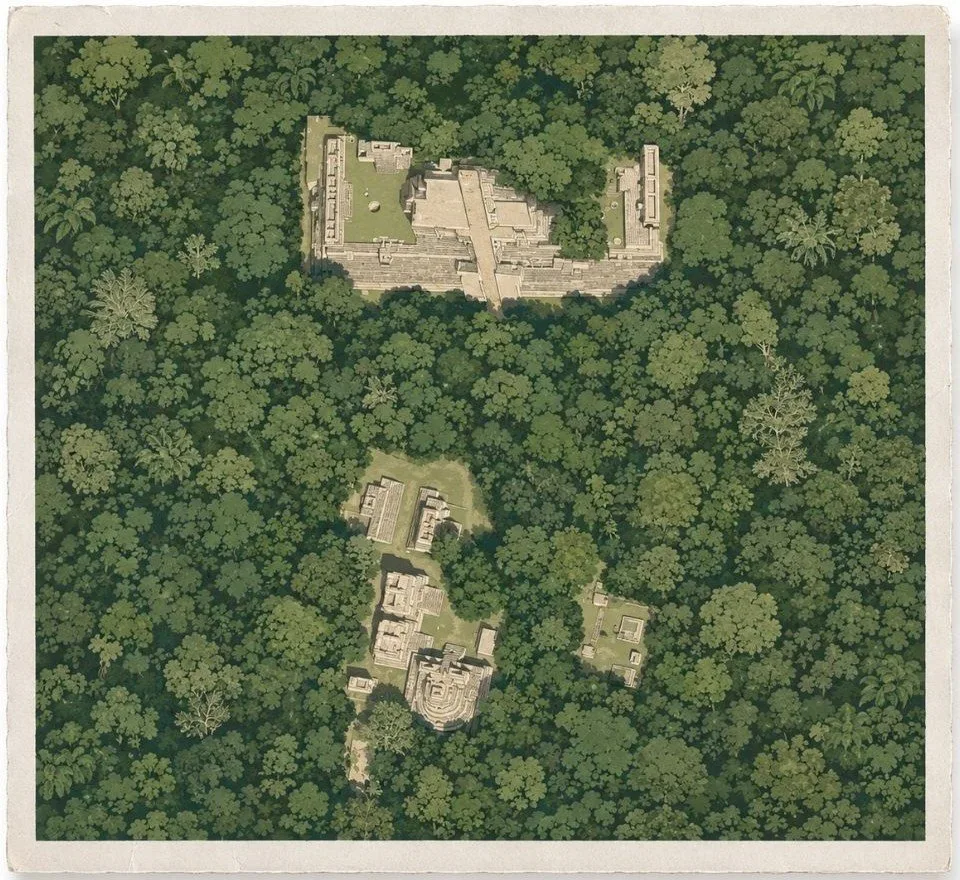
The walled center of Ek’ Balam belongs mainly to a brief period of extraordinary Late Classic power, but Maya communities had been living here for centuries before it took that form. Ceramic evidence carries occupation back into the Middle Preclassic, while settlement continued through the Classic and Postclassic periods and into the era of Spanish contact. By the late eighth century, Ek’ Balam had become the capital of the kingdom of Talol, commanding a network of communities across northeastern Yucatán. Five sacbeob led outward from the monumental core, while walls, plazas, carved stelae, a ballcourt, and palatial buildings concentrated political authority inside it.
Ek’ Balam reached its height between about 770 and 896 CE, especially under Ukit Kan Le’k Tok’. His reign marked a surge of construction, sculpture, painting, and writing unlike anything previously attempted at the city. Talol drew labor and resources from settlements under its authority, allowing its rulers to build on a scale far beyond what the population of the central city could have supplied alone. The enclosed royal center became increasingly elaborate, with controlled entrances and a vaulted passage leading through the walls toward the principal plazas.A stela dated to 840 CE still shows Ukit Kan Le’k Tok’ above a later ruler, preserving him as a powerful figure in the dynasty that followed.
The greatest expression of that royal building program was the Acropolis, a vast palace rising through six architectural levels on the north side of the city. Measuring about 160 meters long, 68 meters wide, and 32 meters high, it contained rooms, stairways, corridors, terraces, and earlier construction buried within later additions. Ukit Kan Le’k Tok’ lived here and was eventually buried within it. His funerary chamber, Sak Xok Naah, the “White House of Reading,” was built into the fourth level behind an enormous modeled-stucco entrance shaped as the open jaws of the Earth Monster. His burial was accompanied by an offering containing more than 7,000 pieces of shell and snail, while sculpted figures, painted rooms, and hieroglyphic texts across the Acropolis recorded the dynasty that had transformed Ek’ Balam.
The artwork preserved on those buildings also shows that Ek’ Balam was developing its own courtly style while drawing on architectural traditions from elsewhere in the northern Maya lowlands. Chenes and Puuc elements appeared alongside elaborate modeled stucco and mural painting, and artists covered parts of the royal complex with figures and texts rather than limiting decoration to isolated doorways. Ek’ Balam’s influence also extended outward. Architectural and artistic techniques developed here appear in the early history of nearby centers, including Chichén Itzá, which was rising as Ek’ Balam’s own period of greatest regional power approached its end.
After the late ninth century, Talol no longer commanded the resources that had supported Ukit Kan Le’k Tok’s enormous building program. Ek’ Balam’s population and political importance declined during the Postclassic, but the city was not simply abandoned after its Classic-period peak. People continued living in and around the old center into the sixteenth century. A colonial Relación Geográfica preserved a later Maya tradition that the kingdom had been founded by a lord called Ek’ Balam or Coch Cal Balam, who came from the east and ruled over other captains and lords. That account belongs to centuries after Ukit Kan Le’k Tok’ and should not be confused with the city’s Classic inscriptions, but it shows that the old capital and its rulers remained part of local historical memory when Spanish colonial rule reached northeastern Yucatán.
Experiences Around Ek Balam
The ruins are only part of the story. Tropical forest and small Maya farming communities spread across this quieter corner of northern Yucatán.
–
Cool off at Cenote X’Canché, reached by a forest path from the archaeological zone, with swimming beneath limestone walls and hanging tree roots.
–
South in Temozón, try the town’s smoked meats and longaniza, a local specialty served in tacos with handmade tortillas.
How to Get There & Where to Go Next
How to Visit Angel Mounds
– Step-by-step access to the site –
- From St. Louis, MO: Drive east on I-64 toward Evansville, about 3 hr 45 min.
- Approach Evansville: Merge onto IN-62 East toward Newburgh, 15 min.
- Final Segment: Follow brown historic site signs to Angel Mounds entrance, 5 min.
- Parking: Free parking at the visitor center adjacent to the museum entrance.
Tips: Check the official site for seasonal hours; plan to combine your visit with the on-site museum for full contex.
Nearby Ruins You Can Visit
Ek Balam belongs to a wider northern and eastern Maya landscape where roads, ceramic exchange, and changing centers of power connected inland kingdoms across the peninsula.
Cobá – Ancient causeways wind through the forest between temple groups, linking towering pyramids and carved stelae across a sprawling Maya city.

Traveler Tips
- Footwear: The Acropolis stairway is steep; shoes with reliable grip matter most on the descent.
- Heat: Morning conditions are easier for the exposed plazas and long Acropolis climb; carry water and sun protection.
- Upper Access: Conservation work can change which Acropolis levels are open, so confirm climbing access at the entrance.
- Museum Time: Admission includes the site museum; allow extra time when the visit is focused on inscriptions and royal history.
- Visit Length: Allow at least two hours for the ruins, longer for slow study of Sak Xok Naah and the museum.
Elsewhere in the Americas…
During Ek Balam’s great building phase in the late eighth and ninth centuries, other centers across the Americas were also concentrating labor, ritual, and political authority into monumental landscapes.

Near Lake Titicaca, Tiwanaku was near its apogee, where massive stone platforms, sunken courts, and planned ceremonial spaces anchored a powerful highland religious and political center.

Mesa Verde was home to expanding Ancestral Pueblo communities, where larger mesa-top villages and above-ground pueblos took shape across the Southwest during the eighth and ninth centuries.
Insider Explorer Advice
Colectivo taxis for Ek Balam gather near the ADO station in Valladolid, leaving once full and running directly to the ruins. Return service thins out later in the afternoon, so leaving the site by about 4:00 PM is the safer plan. Inside Ek Balam, the route steadily tightens. Visitors pass through outer structures, walls, and vaulted gateways before entering increasingly enclosed plazas, with each layer drawing the path closer to the royal core. The Acropolis rises at the end of that progression, its scale becoming clear only after the surrounding architecture has already narrowed the field around it. Higher on the structure, the great stucco façade deserves time of its own, both for its size and for the remarkable amount of surviving stucco sculpture still visible across it
Summary: Ek Balam preserves a walled royal center where the Acropolis, dynastic inscriptions, and Sak Xok Naah still reveal the architecture of Talol’s court.