
El Tajín
MEXICO /VERACRUZ / TOTONAC
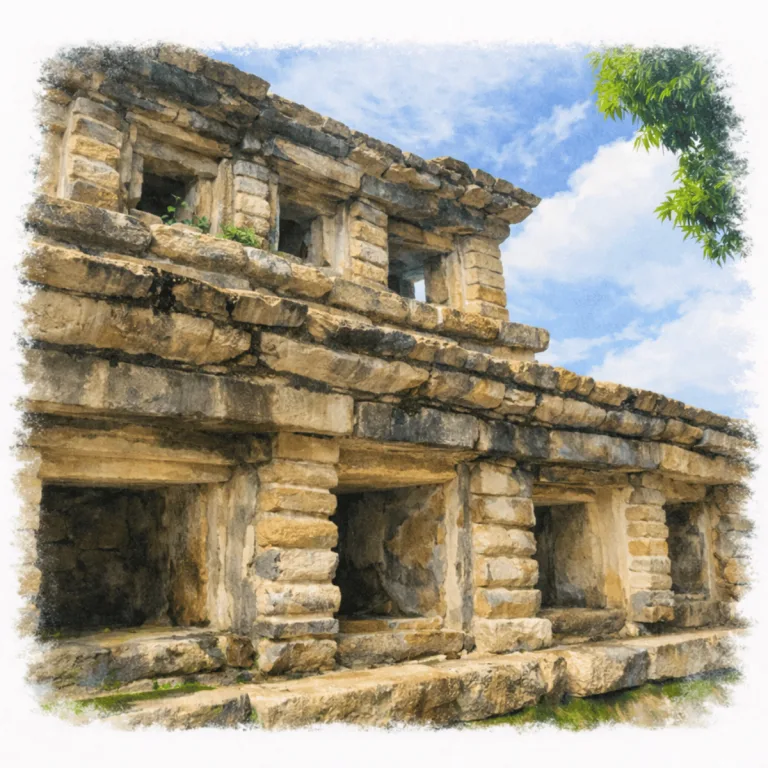
Across a network of streams in northern Veracruz, El Tajín concentrates pyramids and courts around the Pyramid of the Niches, where 365 recessed panels mark the solar year in stone.
| Name | El Tajín |
| Civilization | Totonac |
| Location | Veracruz, Mexico |
| Elevation | 242 feet (about 74 meters) |
| Years Active | c. 600 – 1200 CE |
| Primary Resources | Limestone, stucco, volcanic rock |
| Site Type | Ceremonial and administrative city |
| Key Highlights | Pyramid of the Niches, ballcourts, unique step-facade temples |
| UNESCO | El Tajín, Pre-Hispanic City |
| Entry Fee | 105 MXN (205.00 MXN Foreign Visitors) |
| Best Time to Visit | Morning or late afternoon for cooler weather |
| Field Visit | Visited & photographed by Lost Ruins of the Americas |
Unique Features of the El Tajín Archaeological Site
- Decorative Reliefs: Carved panels show rituals, processions, and cosmological figures across temples and ballcourts.
- Step-Facade Temples: A rare architectural style using recessed panels for visual texture.
- Multiple Ballcourts: With over a dozen courts, the site reflects a deep ritual emphasis.
- Expansive Layout: Hidden clusters and wide plazas invite deeper on-foot exploration.
- Traces of Color: Faint blue and red pigments survive on select temple surfaces.
- Tajín Chico Views: Elevated structures offer wide vantage points over the southern complex.
Location & Access
- Nearest Town: Papantla de Olarte, Veracruz. The archaeological zone is about 9 kilometers from the town center.
- Directions: From Papantla, follow the signed road toward El Tajín and Poza Rica. The entrance is reached in about 15 minutes by car or taxi.
- Official Site: INAH Zona Arqueológica El Tajín.
- Opening Hours: Daily, 9:00 AM to 6:00 PM. Last admission is at 5:00 PM.
- Entry Fees: 105 MXN for Mexican nationals and foreign residents; 210 MXN for foreign visitors. Admission includes the site museum.
- Facilities: Parking, restrooms, restaurant, shop, lockers, guided visits, medical assistance, and the El Tajín Site Museum.
- Accessibility: Partial. Visitor services and some central areas are accessible, but uneven ground, slopes, and stone stairways limit access through parts of the site.
- Pro Tip: Arrive when the gates open and tour the exposed plazas first. Save the museum for later, when the Gulf heat and humidity begin to build.
Highlights to Help Understand Your Visit
El Tajín is not just visually striking. It is a city encoded with ritual, rhythm, and cultural transitions. These cues can help you see the site with sharper eyes:
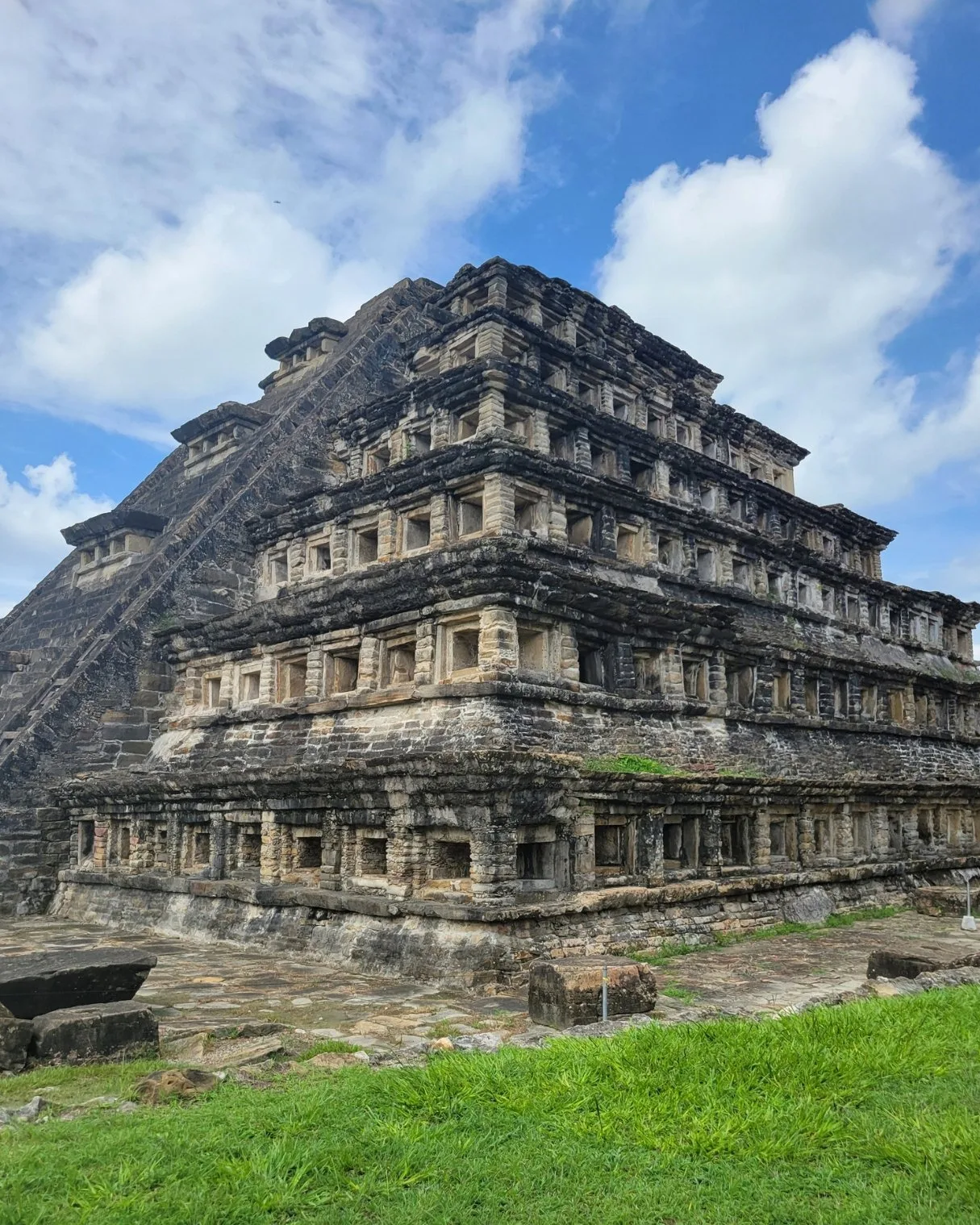
- Count the Niches: The Pyramid of the Niches holds exactly 365, not just decorative but tied to solar cycles and ritual timekeeping.
- Ballcourts as Stages: El Tajín’s many ballcourts weren’t for sport. They were theatrical spaces, with carved panels showing sacrifices and mythic reenactments.
- Rhythmic Architecture: Step-facade temples use recessed panels that repeat like a pattern, a visual rhythm echoing the ceremonial rhythms of the site.
- Layers of Abandonment: Notice how some structures seem unfinished or eroded. These are clues to El Tajín’s sudden decline and centuries of jungle reclamation.
- Color and Shadow: Original red and blue pigments once accented niches and walls. Look for traces where shadow and moisture linger.
Key Structures of the El Tajín Ruins
- Pyramid of the Niches: The most iconic structure at El Tajín, with 365 recessed niches believed to reflect the solar calendar. Its seven-tiered design and shadow play reveal astronomical precision.
- South Ballcourt: Known for its carved stone panels depicting rituals tied to the Mesoamerican ballgame, including themes of sacrifice and divine rebirth.
- North Ballcourt: A well-preserved ceremonial court with murals showing uniformed players and narrative sequences from local mythology.
- Building of the Columns: A multi-chambered temple featuring tall carved pillars, possibly linked to elite gatherings or ceremonial rulership.
- Templo Azul (Blue Temple): Elevated temple structure with traces of original blue pigment. Its layout suggests solar alignment and ritual function.
- Great Xicalcoliuhqui: A massive walled complex in the shape of a stepped spiral. The design may reference sacred enclosures or cosmic journeys.
- Tajín Chico Complex:
- Palace Y: A probable administrative or elite residential building. Features include stone mosaics, water channels, and complex room layouts.
- Building K: Set on an elevated platform, this temple offers wide views of the southern precinct and may have served a calendrical or civic role.
- Building N: Possibly used for astronomical observation. Its placement and axis suggest a connection to solar or planetary events.ramid of the Niches: El Tajín’s centerpiece with 365 niches symbolizing the calendar cycle.
- South Ballcourt: Features preserved reliefs showing human sacrifice and elite rituals.
- Building of the Columns: Multi-room temple featuring impressive carved columns and porticos.
- North Ballcourt: One of the best-preserved, with murals depicting players and mythological scenes.
- Temple Blue (Templo Azul): Notable for traces of pigment and elevated staircases.
- Great Xicalcoliuhqui: Walled ceremonial complex forming a spiral motif — interpreted as cosmological in nature.
- Area of Tajín Chico:
- Palace Y: Elite residential or administrative space with mosaic-style wall art.
- Building K: Elevated temple with panoramic views of the southern section.
- Building N: Structure with possible astronomical alignments.
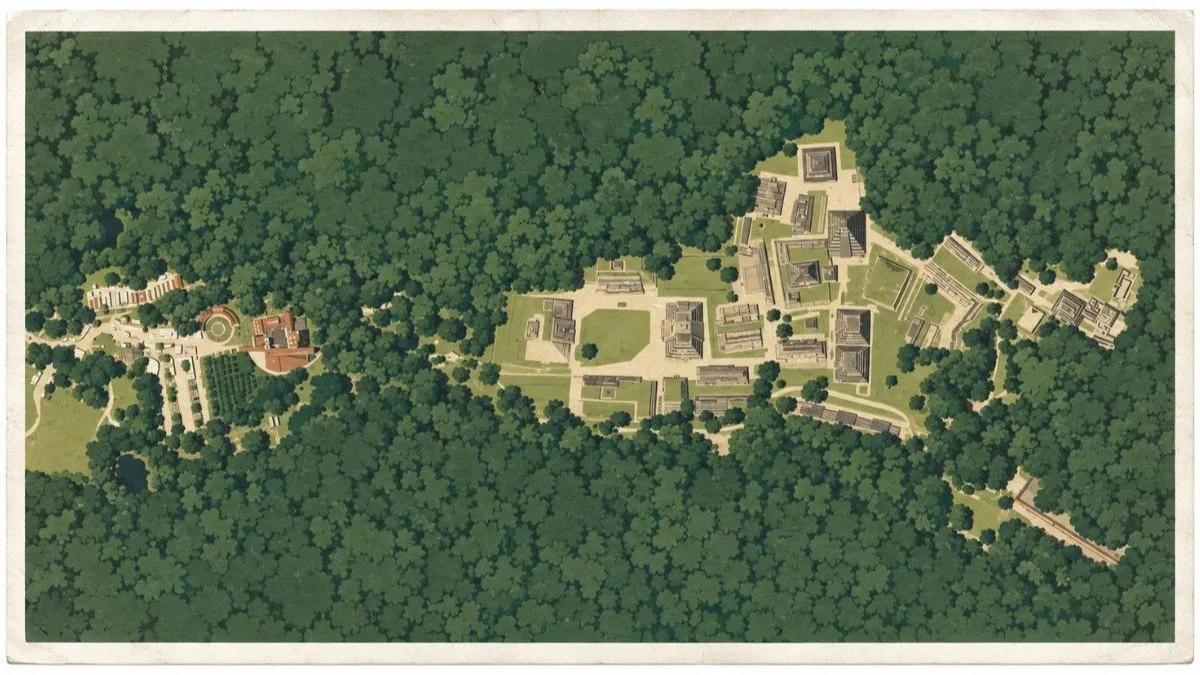
History and Legends
El Tajín was one of the most influential cities of ancient Mesoamerica during the Classic and Early Postclassic periods, flourishing between 600 and 1200 CE. Its name is often linked to a Totonac deity of thunder or lightning, though the site’s true original name remains unknown. Strategically located in the lush northern Veracruz region, El Tajín rose to prominence after the decline of the Teotihuacan sphere, developing its own unique architecture, iconography, and ritual systems that set it apart from its contemporaries.
The city’s defining feature, the Pyramid of the Niches, demonstrates advanced understanding of calendrical cycles and architectural symmetry. With 365 recessed niches across its six levels, the pyramid is widely interpreted as a solar monument marking the passage of time. It also served as a spiritual anchor for the city’s ceremonial core. Surrounding it were plazas, temples, elite residences, and the most ballcourts of any known Mesoamerican site, over a dozen in total, indicating the central role of ritual ballgames in public life and religious practice.
El Tajín’s ballcourts were not just sporting arenas. They were stages for cosmic drama. Carved panels show masked priests, captives, and scenes of decapitation or divine rebirth, reinforcing the belief that the ballgame symbolized the struggle between light and darkness, life and death. These reliefs, along with architectural innovations like step-facade temples and complex drainage systems, reveal a city deeply invested in both visual storytelling and engineered control of its environment.
While often associated with the Totonac people, El Tajín’s origins likely predate the emergence of Totonac identity as we understand it today. Its cultural development was likely influenced by earlier Gulf Coast traditions, such as those of the Olmec and Classic Veracruz cultures. By the 12th century, however, the site was largely abandoned, possibly due to conflict, shifting trade routes, or ecological pressures. Over time, jungle growth enveloped its structures, preserving many of the city’s carvings and walls beneath layers of vegetation.
El Tajín was rediscovered by European explorers in the late 18th century and later became one of Mexico’s most studied archaeological zones. Yet much about it remains cloaked in mystery. Local legends speak of divine protectors within the Pyramid of the Niches, and some claim hidden chambers still lie sealed beneath the earth. For many visitors, the true power of El Tajín lies in its ability to evoke a world where stone, time, and ceremony were inseparable, a city of shadow, light, and eternal return.
Experiences Around El Tajín
El Tajín lies in the humid hills of Totonacapan, surrounded by tropical vegetation and vanilla-growing country.
–
In Papantla, walk the zócalo and continue into Mercado Hidalgo at its northwest corner for zacahuil, vanilla pods, extracts, and regional produce.
–
Nearby Museo Teodoro Cano shows the Papantla-born artist’s paintings and murals alongside traditional Totonac clothing and scenes of everyday life in the region.
How to Get There & Where to Go Next
How to Visit El Tajín
Step-by-step access to the site
• From Mexico City Drive to Papantla, Veracruz via the México-Pachuca route and 132D (about 6 hours).
• Nearest Town Papantla is the main base for visiting El Tajín.
• Final Stretch From Papantla, El Tajín is about 20 to 30 minutes by road.
• On Site Allow about 2 to 3 hours to see the main ruins and museum.
Tips: Arrive early for cooler temperatures and lighter crowds. El Tajín is open daily from 9:00 AM to 6:00 PM.
Nearby Ruins You Can Visit
These ceremonial cities echo El Tajín’s legacy, with ballcourts, carved iconography, and evolving Gulf Coast power structures shaped by ancient ritual and myth.

Cacaxtla – Murals of deities and warriors show a Gulf-linked power steeped in cosmology and regional control.

El Cuajilote – A Totonac hilltop site with plazas and temples still anchored in mystery and mist.

Yohualichan – Sister city to El Tajín, with shared architecture and cultural continuity deep in the Sierra Norte.
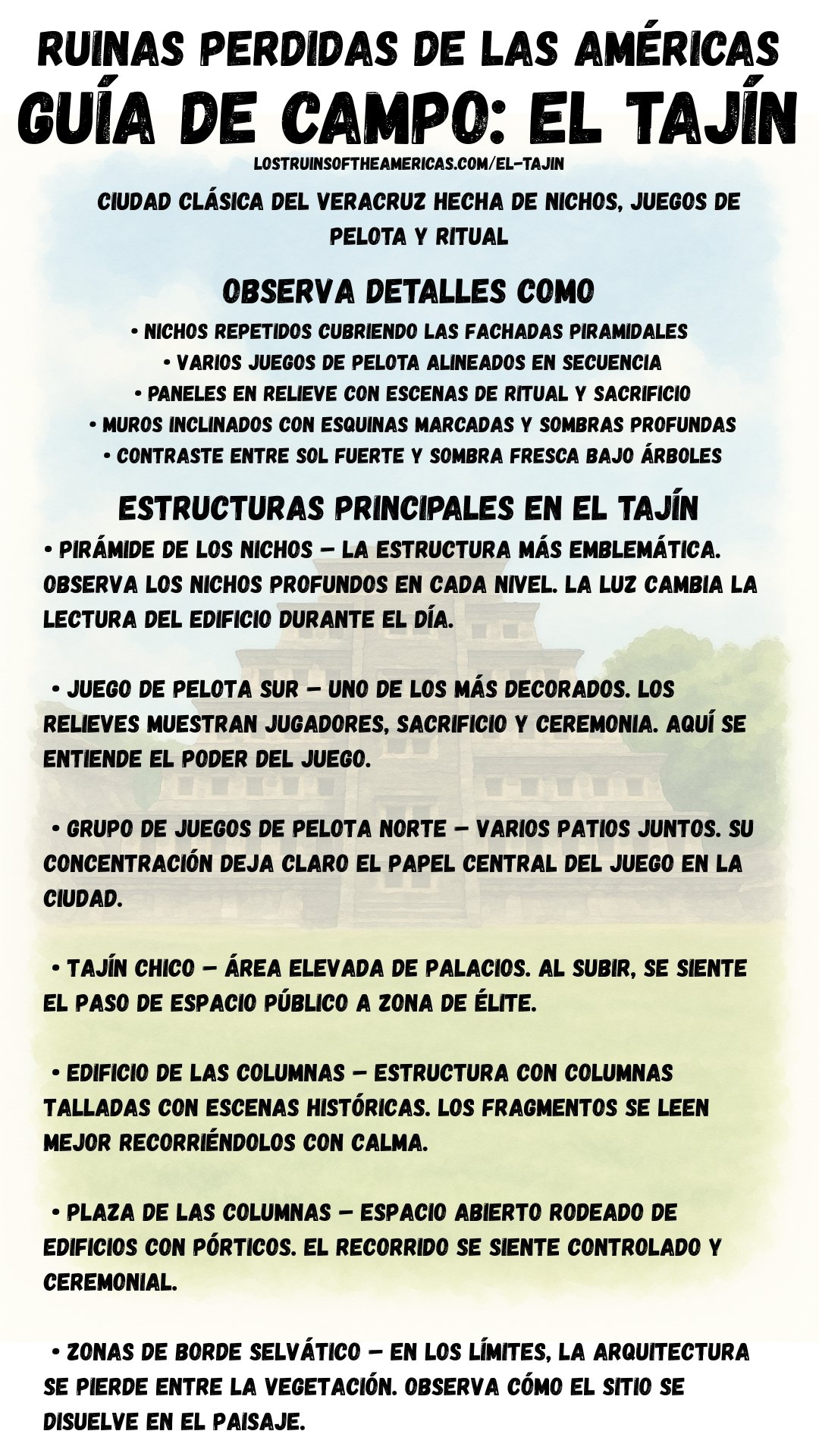
Download Field Guide
Español
English
Traveler Tips
- Visit early to beat the heat and avoid crowds. Shade is limited but available near trees and perimeter walls.
- Wear sun protection and bring water. Much of the site is exposed.
- Hire a guide for interpretation. There’s minimal signage.
- Combine your visit with a stroll around Papantla’s zócalo in the evening.
- Check for Danza de los Voladores performances in the town plaza.
Elsewhere in the Americas…
As El Tajín flourished along the Gulf Coast, other cultures across the Americas were shaping regional power and ceremonial traditions:

In the Andes, Kuélap developed as a fortified highland center with massive stone walls and circular dwellings.

In Colombia, El Infiernito served as a ceremonial site with stone pillars aligned to seasonal cycles.

Insider Explorer Advice
Base yourself in Papantla, a lively and authentic town with excellent street food and a buzzing zócalo that comes alive at night. The colectivo lot a few blocks west of the main square is the best way to reach the ruins. Vans depart regularly and return from the same point. Before or after visiting the ruins, take time to walk the length of the plaza mural by Teodoro Cano García. It’s a vivid visual history of the region from creation to modern day. Inside the site, shade is sparse, but you’ll find pockets under trees or near the edge zones. And the Pyramid of the Niches is like nothing else. Be sure to see it from multiple angles, as the light plays dramatically across its carved shadows.
Summary: El Tajín preserves a Totonac ceremonial city of pyramids, ballcourts, niches, and carved reliefs, where architecture turned ritual movement into visible order.