
The Olmec Civilization:
Mother Culture of Mesoamerica
Olmec World
Long before the Maya built their temple-pyramids or the Aztecs raised Tenochtitlán, a mysterious people carved giant stone heads from volcanic basalt and placed them in jungle clearings along the swampy coasts of southern Mexico.
They were the Olmec – a name we gave them. We don’t know what they called themselves. We don’t know exactly what language they spoke. But we know this: their ideas shaped Mesoamerica for over two thousand years.
The Olmecs weren’t just early, they were foundational. Sacred kingship, urban planning, calendar systems, hieroglyphic writing, and the symbolic grammar of the cosmos — it all began here.

Civilization Snapshot
| Category | Info |
|---|---|
| Region | Gulf Coast of Mexico (modern-day Veracruz and Tabasco) |
| Timeframe | ~1600 BCE – 400 BCE (peaked ~1200–600 BCE) |
| Capital / Major Cities | San Lorenzo, La Venta, Tres Zapotes |
| Peak Population | Est. tens of thousands across major ceremonial centers (~1000 BCE) |
| Language(s) | Unknown (possibly Mixe-Zoquean) |
| Known For | Colossal stone heads, sacred iconography, early writing, pyramid platforms |
| Cultural Relatives | Zapotec, Maya, Epi-Olmec, Izapan |
| UNESCO Sites | None currently inscribed, but La Venta and San Lorenzo are protected zones |
The Olmec Heartland
The Olmecs rose in the Gulf Coast lowlands, in what is now the Mexican states of Veracruz and Tabasco. This region is a hot, humid tangle of rivers, swamps, and fertile floodplains — ideal for early agriculture but difficult to tame.
Around 1600 BCE, small farming communities began cultivating maize, beans, squash, and cacao, eventually giving rise to larger ceremonial centers. The first true Olmec city was San Lorenzo, founded by 1200 BCE.
By 1000 BCE, the Olmecs had carved canals, built artificial terraces, and erected massive basalt monuments. San Lorenzo was followed by La Venta — a new ceremonial capital dominated by a 110-foot-high earthen pyramid and a precise north-south layout that would echo through future Mesoamerican cities.
Colossal Heads and Sacred Kingship
Perhaps the most iconic relics of the Olmec world are the colossal heads, carved from single basalt boulders weighing up to 50 tons.
These heads aren’t abstract or mythical, they’re portraits. Each wears a distinct helmet or headdress, with expressive lips, wide noses, and stern gazes. They likely represent individual rulers or elite ballplayers, embodying both political and ritual power.
Moving these stones, some from quarries over 60 miles away required complex organization, labor, and likely a theological justification. These weren’t just monuments; they were embodiments of divine authority.
The Olmecs didn’t separate politics from spirituality, rulership was sacred. Kings were intermediaries with the spirit world, and Olmec art reflects that blending of human and divine.
Symbols, Glyphs, and Sacred Scripts
Olmec artists and scribes developed one of the earliest known writing systems in the Americas. At sites like San Andrés and Cascajal, archaeologists have found:
- Incised glyphs and signs on stone, shell, and greenstone
- Possible calendrical notations and name glyphs
- The Cascajal Block, a serpentine tablet with 62 carved symbols (possibly a complete text)
Though their writing remains undeciphered, it predates the earliest Maya glyphs and shows that the Olmecs weren’t just builders — they were record keepers, ritualists, and storytellers.
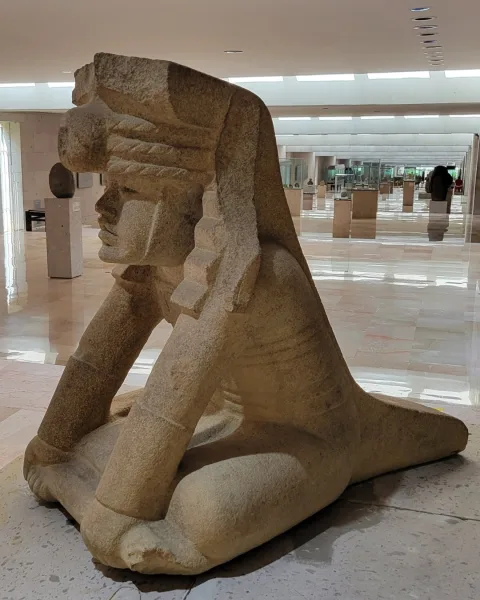
Their iconography , jaguars, flame brows, were-jaguars, and celestial bands became the visual grammar of power across Mesoamerica.
Religion and the Sacred World
Olmec religion was rooted in a tripartite cosmos: sky, earth, and underworld. Caves, water sources, and mountain-shaped pyramids served as axis mundi, places where the divine and mortal worlds intersected.
- The maize god – associated with fertility, cycles, and rebirth
- Were-jaguar figures – hybrid beings symbolizing shamanic transformation
- Ballcourts and ritual plazas – used for cosmic reenactments and power performances
- Bloodletting and sacrifice – depicted in carvings, suggesting early ceremonial practices
These spiritual elements didn’t disappear – they became foundations of Mesoamerican religion, passed down and reinterpreted by the Maya, Zapotec, Mexica, and more.
Trade, Power, and Reach
Though the Olmec heartland was geographically isolated, it wasn’t culturally cut off. The Olmecs created vast trade networks that extended far beyond the swamps of Veracruz.
- Obsidian from highland Guatemala and Puebla
- Jade and serpentine from Motagua Valley
- Hematite mirrors and iron ore
- Shells and stingray spines from distant coastal regions
These goods weren’t just commodities, they were ritual currencies, woven into elite identity and spiritual practice. Through trade, Olmec style spread far – appearing in sculptures, reliefs, and architectural planning well outside their homeland.
Echoes Through Mesoamerica
The Olmecs didn’t vanish, they diffused. Their symbols and structures took root in new soils and new cultures, from the highlands of Morelos to the northern Gulf and beyond.
- The Maya adopted calendar systems, cosmic kingship, and ceremonial layouts
- The Zapotecs mirrored their tomb architecture, glyphic systems, and elite rule
- The Epi-Olmec carried forward the visual and spiritual legacy into the Classic period
- The Totonacs centuries later in the El Tajín region, likely inherited ritual logics and sacred urbanism rooted in Gulf Coast precedent
The Olmecs weren’t just first, they were the template. They mapped time, built cities aligned to the heavens, and carved divine authority into stone. Their world echoes forward in every major Mesoamerican civilization that followed.
Where to See the Olmec Today
While many Olmec sites are remote or eroded, the civilization’s legacy is beautifully preserved in one place: the Museo de Antropología de Xalapa in Veracruz.
This world-class museum, often just called MAX, houses one of the most comprehensive collections of Olmec artifacts anywhere, including:
- Several original colossal heads relocated from San Lorenzo and La Venta
- Exquisite jade and greenstone figurines
- Ritual altars, incised celts, and ceremonial axes
- Contextual displays on Olmec cosmology, trade, and influence
If you want to stand face-to-face with the Olmec, this is where you do it. The museum’s open-air design and lush tropical gardens make it an experience not just an exhibit.
The Mystery Endures
We still don’t know what the Olmecs called themselves. Their language is lost. Their cities overgrown. Their texts, if they had them mostly vanished. What remains are fragments of a worldview that once organized everything from maize fields to mountain altars.
And yet, their presence is undeniable. In stone heads and sacred geometry. In ritual symbols that never quite went extinct. In the bones of cities that still align to sunrise and equinox.
To stand at La Venta or San Lorenzo — or even to walk among the weathered reliefs of distant sites touched by Olmec thought — is to trace the outlines of a civilization that never needed an empire to change the world.

Olmec Ruins You Can Visit
- La Venta – Massive earth mounds, altars, and colossal heads
- San Lorenzo – One of the earliest Olmec centers with sculpture and hydraulic systems
- Tres Zapotes – Features later monuments and stelae including one of the oldest Mesoamerican calendar dates
- Chalcatzingo – Highland site with Olmec-style reliefs and elite imagery carved into rock outcrops
Explore Related Civilizations
- Zapotecs – Carried forward calendar and sacred kingship systems
- Maya – Likely inherited iconography, writing, and ceremonial layouts
- Teotihuacan – Later center of urban ritualism with indirect Olmec echoes
- Mixtecs – Successors in ritual art and cosmology